
www.oilgastechnology.com
27
'26
Written on Modified on
Tight Reservoir Recovery Optimization on Continental Shelves
Equinor and Aker BP collaborate on standardized well stimulation to unlock low-permeability oil and gas formations across offshore fields.
www.equinor.com
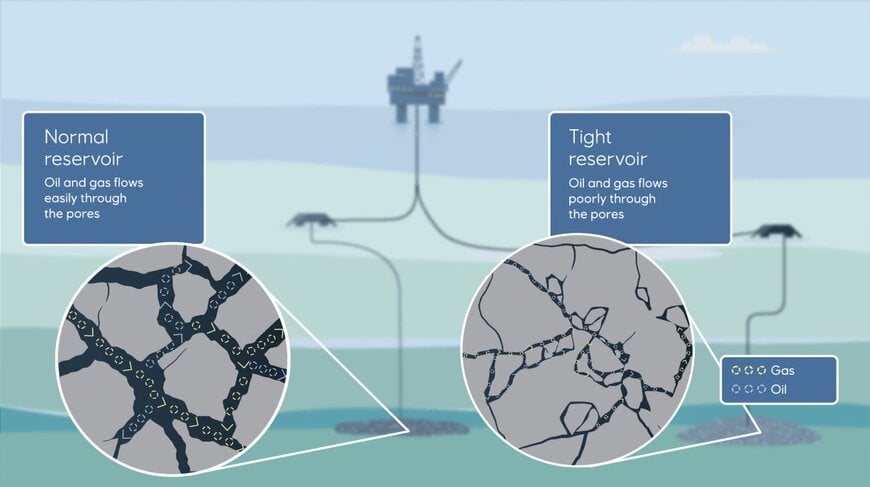
Equinor ASA and Aker BP ASA established a joint technology development initiative targeting low-permeability formations across the Norwegian continental shelf. The engineering framework focuses on standardizing offshore extraction methods and stimulation techniques to improve hydrocarbon recovery rates from geologically complex, low-flow rock formations.
Challenges in Low-Permeability Hydrocarbon Reservoirs
Tight formations present severe extraction constraints due to low matrix permeability, which restricts natural fluid mobility through the rock pores. Data from the Norwegian Offshore Directorate indicates that mapped tight formations across the continental shelf hold an estimated 12 to 13 billion barrels of oil equivalent in place. However, conventional recovery mechanisms remain constrained. Sandstone formations yield average recovery rates of 12 percent for oil and 25 percent for gas, while chalk and limestone reservoirs average 20 percent for oil and 30 percent for gas.
Approximately 90 discoveries on the continental shelf await development approval, with a significant portion located in tight reservoirs. The geological characteristics prevent economical drainage via standard drilling programs, necessitating specialized reservoir stimulation and multi-field standardization to justify project development.
Technical Strategy and Production Standardization
The operational agreement addresses portfolio-wide scale to accelerate technology qualification and reduce development costs. The technical scope centers on advanced well stimulation solutions, standardized completion architectures, and joint resource maturation models. By aligning subsurface data and technical requirements across disparate discoveries, the operators establish common equipment specifications and repeatable operational procedures.
Kjetil Hove, Executive Vice President for Exploration and Production Norway at Equinor, stated that viewing portfolios in context and developing common solutions enables operators to reduce costs, as well as develop and qualify technology faster to make challenging resources profitable.
Cross-Field Implementation Framework
Implementation is structured around a unified governance model supported by multidisciplinary technical teams from both operators. The working groups evaluate shared prospects, integrate subsurface data, and coordinate field-testing programs across license boundaries. Joint technical qualification programs will standardize downhole configurations, stimulation fluids, and drainage strategies.
Karl Johnny Hersvik, Chief Executive Officer of Aker BP, noted that considering opportunities across both portfolios creates the operational scale necessary for faster learning, reduced costs, and the development of solutions applicable across multiple projects.
Operational Impact and Field Maturation
The engineering program directly addresses a recoverable resource base estimated at 2.8 billion barrels of oil equivalent by the Norwegian Offshore Directorate. Deploying cross-portfolio stimulation methods and uniform equipment standards provides the operational predictability required to mature marginal assets into active offshore developments. Standardized procurement and operational protocols also establish a steady capacity within the offshore supply chain, lowering the economic threshold for future tight-reservoir extraction.
Edited by Evgeny Churilov, Induportals Media - Adapted by AI.
www.equinor.com
