
www.oilgastechnology.com
27
'26
Written on Modified on
Industrial AI Optimization for Continuous Process Plants
Honeywell Technologies launched Forge Plant Cognition, an industrial AI platform engineered with Nvidia computing and Dell infrastructure to resolve operational constraints in refining.
www.honeywell.com
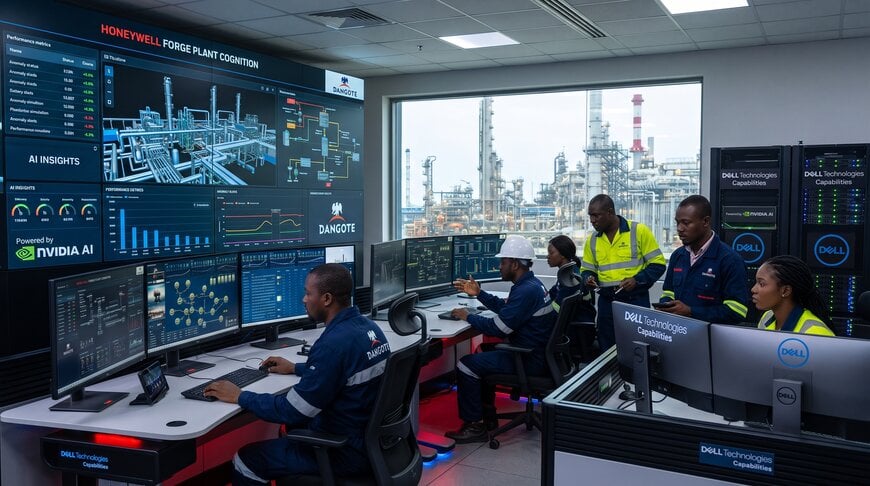
Continuous process operations in downstream hydrocarbons, petrochemicals, and liquefied natural gas facilities operate under severe thermodynamic constraints where minor shifts in operating envelopes create multimillion-dollar margin variations. To address process volatility, yield losses, and skilled workforce bottlenecks across heavy industrial infrastructure, Honeywell Technologies introduced Forge Plant Cognition. The platform pairs first-principles thermodynamic models with accelerated AI to automate plant-wide decision support.
The deployment debuts at the Dangote Petroleum Refinery in Lekki, Nigeria, one of the world's largest single-train facilities. For this specific asset, baseline operational projections indicate that AI-driven process optimization could yield over 29 cents per barrel in operational value, scaling to more than 60 million dollars in annual gross benefit at full design capacity. The initiative also supports Dangote's expansion plan to increase site capacity from 650,000 to 1.4 million barrels per day within a three-year timeframe, alongside internal mandates to scale a local engineering workforce to 70 percent domestic technical staffing.
System Architecture and Physics-Informed Computational Framework
Conventional digital monitoring tools rely heavily on statistical curve-fitting and decoupled predictive maintenance dashboards that lack thermodynamic validation. Forge Plant Cognition combines real-time industrial telemetry, deep process engineering expertise from Honeywell Technologies UOP, and deterministic engineering calculations with neural network models. The software runs on hardware and software architectures configured through the Dell AI Factory with Nvidia, utilizing high-density server configurations with Nvidia RTX Pro 6000 and RTX Pro 4000 hardware. Computational workflows operate across four distinct layers:
- Dynamic Operational Ingestion: Nvidia Nemotron open models parse, structure, and interpret high-frequency operational telemetry from distributed control systems (DCS), acting as autonomous agents that convert process alarms and historian records into actionable operator advisories.
- Physical and Kinetic Modeling: The Nvidia PhysicsNemo framework trains and runs physics-based neural networks, running fluid dynamics and mass-balance simulations at speeds unachievable with classical solver mathematics.
- Process Digital Twins: Nvidia Omniverse libraries render dynamic simulation models of unit operations, enabling engineering teams to run offline scenario planning, de-bottlenecking assessments, and digital training scenarios.
- Computer Vision and Anomaly Detection: Nvidia Cosmos foundation models deployed with the Nvidia Metropolis VSS Blueprint process video feeds across critical process units to detect physical anomalies, leaks, and mechanical irregularities.
Operational Execution and Process Economics
In heavy hydrocarbon processing, production teams face conflicting trade-offs between distillation column temperature profiles, catalyst degradation rates, and product delivery specifications. Forge Plant Cognition divides these challenges into three discrete workflows:
In heavy hydrocarbon processing, production teams face conflicting trade-offs between distillation column temperature profiles, catalyst degradation rates, and product delivery specifications. Forge Plant Cognition divides these challenges into three discrete workflows:
- Capturing Process Margin: Identifying dynamic constraints across interconnected units — such as fluid catalytic crackers, hydrocrackers, and fractionators — to adjust yields in real time against prevailing product pricing.
- Asset Protection: Flagging sensor drift, thermal degradation, and mechanical stress prior to threshold trips, minimizing unplanned shutdowns in high-capital assets.
- Knowledge Institutionalization: Codifying proprietary chemical engineering rule sets directly into the operator loop, reducing the learning curve for early-career operations personnel and standardizing operational responses across shifts.
The implementation at the Lekki site reinforces local engineering workflows by directly embedding UOP's domain knowledge into daily operator consoles, mitigating dependence on overseas technical services during routine troubleshooting.
Additional Context
This section details technical specifications and competitive benchmarking not included in the original product announcement.
Industrial AI platforms targeting the continuous process industries represent an architectural shift away from pure black-box machine learning toward physics-informed neural networks (PINNs). In chemical processing, unconstrained statistical models frequently propose operational parameters that violate basic mass-energy balances or ASME safety margins. Systems integrating verified first-principles formulations circumvent this risk by strictly bounding AI outputs within verified operational safety envelopes.
Within downstream refining and chemical production, comparable optimization platforms include AspenTech's Aspen DMC3 and Aspen Hybrid Models, which similarly blend empirical plant data with mechanistic kinetics, as well as Yokogawa's real-time dynamic optimization solutions. While traditional advanced process control (APC) software relies on linear step testing and matrix math executing on localized plant servers, recent developments integrate distributed GPU clusters and enterprise-wide digital twins to model entire value chains simultaneously. Compliance with open automation standards, such as the Open Process Automation Standard (O-PAS) formulated by The Open Group, alongside strict adherence to ISA/IEC 62443 industrial cybersecurity protocols, has become the mandatory baseline for enterprise AI adoption across large-scale refining facilities.
Edited by Evgeny Churilov, Induportals Media - Adapted by AI.
www.honeywell.com
