
www.oilgastechnology.com
26
'26
Written on Modified on
LNG Dehydration and Heavy Hydrocarbon Removal Systems
PSB Industries utilizes temperature swing adsorption technology in skid-mounted systems to remove moisture and heavy hydrocarbons before natural gas liquefaction.
psbindustries.com
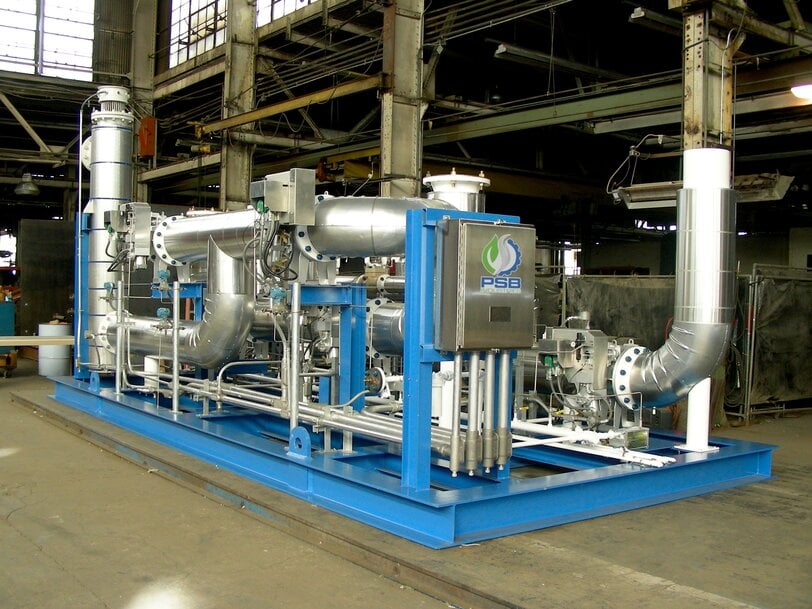
Before natural gas can undergo cryogenic liquefaction, plant operators must eliminate trace moisture and heavy hydrocarbon contaminants that cause structural freeze-ups, ice formation, and damage to downstream cold boxes. To address these operational demands, PSB Industries provides custom skid-mounted temperature swing adsorption systems designed to achieve ultra-dry gas specifications and purify feed streams in small-scale and peak-shaving facilities.
Operational Challenges In LNG Feed-Gas Treatment
Water vapor present in raw natural gas creates severe operational hazards during low-temperature processing, including hydrate formation, valve blockages, instrumentation failures, and catastrophic damage to cryogenic heat exchangers. Furthermore, heavy hydrocarbon components such as C6+ fractions, naphthalene, benzene, and toluene can solidify inside cryogenic plate-and-fin heat exchangers, leading to flow restrictions and off-spec liquefied natural gas production. Controlling these impurities is essential for maintaining plant efficiency and preventing unplanned shutdowns.
Temperature Swing Adsorption Operating Principles
The purification process relies on molecular-sieve based temperature swing adsorption to strip water and heavy hydrocarbons from the gas stream. The closed-loop water removal configuration features zero gas emissions and utilizes dry product gas for thermal regeneration powered by either electric or gas-fired heaters. Depending on operational parameters, regeneration cycles can operate in open, semi-closed, or closed loops. High-efficiency coalescing and particulate filters positioned upstream protect the zeolite adsorbent media from liquid aerosols, while downstream filters capture particulate dust before the gas enters the liquefaction train.
Measurable System Specifications And Performance Parameters
Dehydration units are engineered for operational flow rates spanning 1 to 200 MMSCFD, working pressures ranging from 150 to 1,450 psig, and inlet temperatures between 50 and 122°F. These units achieve outlet water concentrations of less than 1 ppmv and dew points falling below -100°C (-148°F). Heavy hydrocarbon removal units handle flow rates from 1 to 100 MMSCFD, operating pressures from 430 to 1,200 psig, and temperatures from 50 to 122°F, delivering outlet moisture levels between 0.1 and 1 ppmv. Single- to multi-layered-bed configurations allow operators to integrate moisture and heavy hydrocarbon removal within a single vessel footprint, reducing capital expenditures and spatial constraints. All manufacturing, fabrication, assembly, sandblasting, painting, and shop testing are completed under one roof at a 350,000-square-foot facility in Erie, Pennsylvania, enabling strict control over project schedules, costs, and quality compliance.
Additional Context:
This section details technical specifications and competitive benchmarking not included in the original product announcement.
Cryogenic liquefaction processes require rigorous feed gas purification to prevent solid deposition at temperatures dipping below -160°C. Industry standards typically mandate specialized alkali metal alumino-silicate zeolite crystals, such as Type 3A molecular sieves, which selectively adsorb water molecules based on precise molecular diameter exclusion while rejecting larger hydrocarbon compounds. Advanced modular skid designs adhere strictly to ASME pressure vessel fabrication codes, incorporating certified pressure ratings and automated switching valves designed to endure high-frequency thermal cycling. Comparative industrial evaluations indicate that multi-layered bed configurations reduce structural footprint requirements by up to thirty percent compared to dual-vessel standalone setups, optimizing capital efficiency for modular peak-shaving installations.
Edited by Sucithra Mani, Induportals editor – adapted by AI.
www.psbindustries.com
