
www.oilgastechnology.com
07
'26
Written on Modified on
Decarbonizing the Oilfield Through Technology and Transition Investment
Energy producers are leveraging digitalization, AI, methane reduction, and carbon capture technologies to lower emissions while improving efficiency, reliability, and long-term operational performance.
" The future of oil and gas isn’t about producing less—it’s about producing each barrel with smarter methods, greater efficiency, and a lighter carbon footprint.”
For years, the global energy transition was framed as a race between fossil fuels and renewables. Today, that narrative is giving way to a more pragmatic reality. Despite rapid growth in renewable energy, oil and natural gas remain fundamental to powering industries, transporting goods, and supporting economic development. Demand is expected to remain resilient for decades, particularly across Asia and other emerging markets.
The industry's challenge, therefore, is no longer simply meeting energy demand. It is meeting that demand while significantly reducing emissions.
That shift is changing how energy companies invest, operate and innovate. Instead of viewing decarbonization as a compliance exercise, many producers now see it as a driver of operational excellence and long-term competitiveness. Capital is increasingly being directed toward technologies that not only reduce greenhouse gas emissions but also improve productivity, lower operating costs and enhance asset reliability.
Deloitte’s 2026 Oil and Gas Industry Outlook notes, companies continue to exercise disciplined capital allocation, prioritizing investments that strengthen financial performance while advancing emissions-reduction goals. Likewise, S&P Global identifies digitalization, artificial intelligence (AI), methane management and carbon capture as some of the defining forces shaping upstream operations in 2026.
In many respects, the oilfield of tomorrow is already being built today.
A Digital Revolution Beneath the Surface
The biggest transformation in oil and gas is not necessarily happening underground—it is happening in the data generated above it.
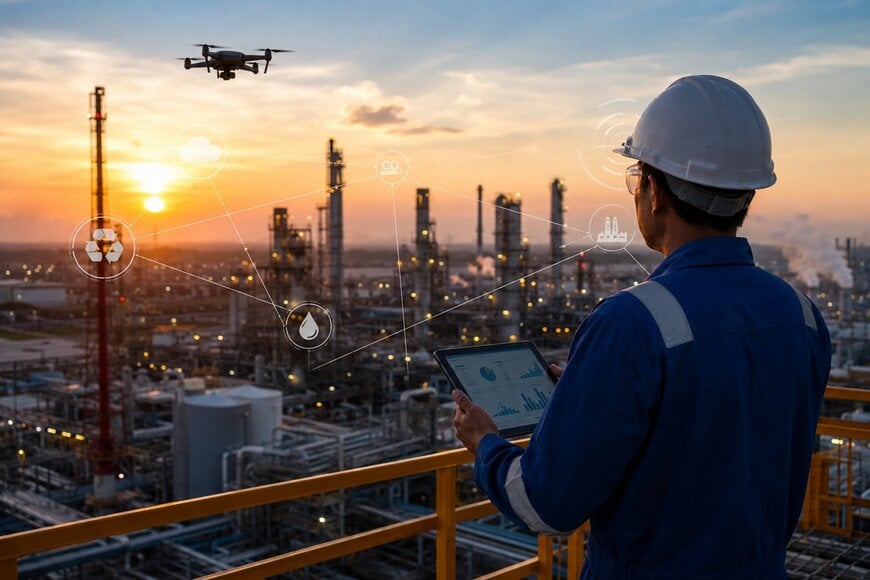
Modern production facilities are becoming highly connected environments where thousands of sensors continuously monitor equipment, wells and pipelines. Cloud computing, AI and industrial Internet of Things (IIoT) technologies are turning vast amounts of operational data into real-time intelligence, enabling operators to make faster and more informed decisions.
This evolution marks a significant departure from traditional oilfield operations, where maintenance often occurred only after equipment failures disrupted production. Today, predictive analytics can detect subtle changes in equipment performance long before problems become critical, reducing downtime while lowering maintenance costs.
More importantly, digitalization has become one of the industry's most effective decarbonization tools.
Every compressor operating at peak efficiency consumes less fuel. Every optimized drilling program minimizes energy use. Every leak detected before it escalates prevents unnecessary methane emissions.
AI is increasingly being used to optimize drilling parameters, improve reservoir modelling and automate production adjustments based on changing operating conditions. Digital twins—virtual replicas of physical facilities—allow engineers to simulate equipment performance, evaluate different production scenarios and optimize operations before implementing changes in the field.
Rather than relying solely on experience and historical data, operators are now making decisions based on continuous streams of live information.
From Digital Oilfields to Digital Sustainability
Technology companies are also redefining how environmental performance is managed.
SLB has expanded its digital sustainability portfolio to help operators measure, monitor and report greenhouse gas emissions across their assets. In collaboration with Saudi Aramco, the company is developing AI-enabled digital sustainability solutions designed to improve methane detection, optimize flare performance and support carbon management initiatives.
Instead of estimating emissions through periodic reporting, operators can continuously monitor carbon performance using integrated digital platforms. The result is greater transparency, faster response times and more accurate sustainability reporting.
Remote monitoring technologies are also changing field operations. Drones inspect pipelines in difficult terrain, autonomous robots conduct facility inspections in hazardous environments, while satellites capable of detecting methane emissions provide operators with visibility across entire production regions.
These technologies improve safety while reducing the need for manual inspections, making operations not only more sustainable but also more efficient.
Carbon Capture Comes of Age
Few technologies have generated as much attention in recent years as carbon capture, utilization and storage (CCUS).
Initially viewed as an expensive and uncertain solution, carbon capture has matured into one of the industry's most important pathways for reducing emissions from existing operations. Rather than eliminating fossil fuel production, CCUS enables companies to continue producing energy while preventing carbon dioxide from entering the atmosphere.
The International Energy Agency continues to identify carbon capture as essential for achieving global net-zero ambitions, particularly for industries where emissions are difficult to eliminate through electrification alone.
What has changed is the scale of investment.
One of the most ambitious developments is taking shape in Saudi Arabia, where Saudi Aramco, together with SLB and Linde, is developing the Jubail Carbon Capture and Storage Hub. Once operational, the project's first phase is expected to capture up to nine million tonnes of carbon dioxide annually, making it one of the world's largest planned carbon storage facilities.
For oil and gas companies, projects like this represent more than environmental stewardship.
They leverage decades of expertise in drilling, reservoir engineering and subsurface geology to create an entirely new business around carbon management. Increasingly, regional carbon storage hubs are being designed to serve multiple industries—from refineries and petrochemical plants to steel and cement manufacturers—turning carbon storage into shared infrastructure rather than a company-specific solution.
Hydrogen Finds Its Commercial Role
Hydrogen is also moving beyond the demonstration stage.
For several years, hydrogen was discussed primarily as a future energy source. Today, integrated energy companies are beginning to position it as a complementary business alongside oil, gas and renewable energy.
Unlike passenger vehicles or residential electricity, industries such as refining, steelmaking, chemicals, shipping and heavy transport cannot easily be electrified. These sectors are expected to drive future hydrogen demand.
Major energy companies are responding accordingly.
Shell continues to expand investments across hydrogen production and infrastructure as part of its integrated energy strategy, while bp is advancing hydrogen alongside renewable power, bioenergy and carbon capture projects.
Blue hydrogen, produced from natural gas with carbon capture, offers an opportunity to utilize existing infrastructure while reducing emissions. Green hydrogen, produced through renewable-powered electrolysis, is expected to become increasingly competitive as renewable electricity costs decline and electrolyzer technologies continue to improve.
Rather than replacing hydrocarbons, hydrogen is gradually becoming another component of diversified energy portfolios.
Measuring Every Molecule
Perhaps one of the most profound shifts taking place across the industry is how emissions themselves are managed.
Only a decade ago, methane emissions were often estimated through engineering calculations and periodic inspections.
Today, they are increasingly measured continuously.
Advanced infrared cameras, fixed methane sensors, drones, satellites and AI-powered monitoring platforms now provide operators with near real-time visibility into emissions across production facilities.
The objective is straightforward: detect leaks quickly, repair them sooner and reduce both environmental impact and product loss.
Digital technologies are also accelerating carbon storage projects.
Halliburton, through its Landmark digital solutions, is applying machine learning to improve the characterization of underground carbon storage formations. By integrating seismic interpretation, geological modelling and AI-driven analytics, engineers can identify suitable CO₂ storage sites more accurately while reducing project uncertainty.
Reliable emissions data has become as strategically valuable as production data. Investors, regulators and customers increasingly expect measurable progress supported by transparent reporting rather than broad sustainability commitments.
Investment Is Following Innovation
Technology alone cannot transform an industry without sustained investment.
That is precisely why transition planning has become central to corporate strategy.
Companies are increasingly directing capital toward projects that generate multiple benefits at once: higher operational efficiency, lower emissions, stronger resilience and improved long-term returns.
This includes electrifying production facilities where feasible, reducing methane emissions, modernizing aging infrastructure, deploying AI-powered operational platforms and expanding carbon management capabilities.
Importantly, these investments are not replacing conventional oil and gas operations.
Instead, they are improving how those operations perform.
Deloitte notes that capital discipline remains one of the defining characteristics of the sector entering 2026. Rather than pursuing aggressive production growth, many operators are prioritizing high-quality assets, technology deployment and operational excellence. The result is a more selective investment environment where financial performance and environmental performance increasingly reinforce one another.
Engineering the Next Generation of Energy
The energy transition is often portrayed as a choice between hydrocarbons and renewables.
For the oil and gas industry, the reality is considerably more complex.
Global energy demand continues to grow, and oil and natural gas will remain indispensable for many years. At the same time, expectations surrounding emissions performance, operational transparency and environmental stewardship are becoming more demanding than ever before.
Meeting both challenges requires innovation—not only in energy sources but in how energy is produced.
AI is sharpening drilling precision. Digital twins help engineers test equipment before it’s deployed. Satellite-based methane detection is transforming environmental monitoring from periodic inspections into continuous oversight. Carbon capture is creating entirely
new infrastructure businesses, while hydrogen is opening opportunities beyond traditional hydrocarbons.
None of these technologies alone will decarbonize the industry.
Together, however, they represent a fundamental shift in how the oilfield is designed, operated and financed.
For an industry built on solving complex engineering challenges, this may be its most important transformation yet. The companies leading the next chapter of oil and gas will not necessarily be those producing the most energy, but those producing it with greater intelligence, greater efficiency and a steadily shrinking carbon footprint.
Article contributed by Kathryn Gerardino-Elagio, Editor-in-Chief, Ringier Trade Media, South East Asia.
