
www.oilgastechnology.com
02
'26
Written on Modified on
Eni commences offshore gas production at Indonesia's Maha field
The subsea tie-back to the Jangkrik FPU will supply up to 250 MMSCFD to domestic and LNG markets.
www.eni.com
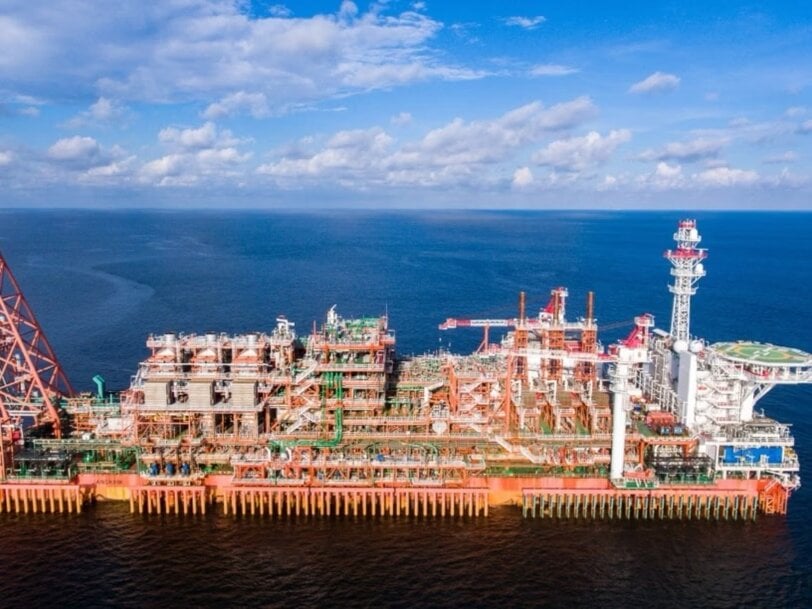
Eni has announced the start-up of gas production from the Maha field in the Kutei Basin, offshore Indonesia, achieving first gas just 21 months after the final investment decision (FID). Located in the West Ganal block at a water depth of approximately 1,000 meters, the field utilizes two subsea production wells connected to the existing Jangkrik Floating Production Unit (FPU) via a 12-kilometer flowline network. Following initial onboard processing, the gas will supply both the domestic market and the Bontang liquefaction plant, which exports LNG globally.
Enhancing the South Hub and Jangkrik FPU
The addition of Maha’s 250 million standard cubic feet per day (MMSCFD) capacity elevates the combined production from the Jangkrik FPU and the broader South Hub to a plateau of 750 MMSCFD. This strategic subsea tie-back maximizes the utilization of existing offshore infrastructure while supporting Indonesia's long-term energy security. Eni expects this production plateau to extend well beyond the end of the decade with the future integration of the Gendalo and Gendang projects, which are scheduled for a 2028 start-up.
Searah joint venture drives regional expansion
The Maha field is operated by Searah, a 50/50 independent upstream joint venture established in June 2026 by Eni and PETRONAS. Managing a portfolio of 19 gas-producing and development assets across Indonesia and Malaysia, Searah currently outputs approximately 350,000 barrels of oil equivalent per day (kboe/d) and targets over 500 kboe/d of sustainable production by 2028. The successful fast-track delivery of Maha, achieved in close coordination with Indonesia’s upstream regulator SKK Migas, underscores the joint venture's strategy to rapidly monetize the prolific resources of the Kutei Basin.
Additional Context: Flow assurance and hydrate mitigation in deepwater tie-backs
This section details multiphase fluid dynamics and subsea engineering principles not included in the original press release.
Developing deepwater offshore fields via subsea tie-backs—where remote wells are connected to an existing host facility like an FPU via kilometers of pipelines—presents severe flow assurance challenges. At a water depth of 1,000 meters, the ambient ocean temperature is near freezing (approximately 4°C). As the hot, multiphase mixture of natural gas, condensate, and formation water travels from the reservoir through a 12-kilometer flowline, the rapid cooling can cause the formation of methane hydrates (ice-like crystalline structures) and wax deposition. If left unmanaged, these hydrates can rapidly agglomerate and plug the pipeline, leading to catastrophic flow blockages and massive production losses. To mitigate this, subsea architectures rely heavily on heavily insulated pipe-in-pipe (PiP) designs to retain heat, coupled with the continuous injection of thermodynamic inhibitors, such as Monoethylene Glycol (MEG), directly at the subsea wellhead. Once the multiphase fluid reaches the FPU, the topside processing modules must separate the MEG from the produced water and gas streams, regenerate it by boiling off the water, and pump it back down to the seabed in a continuous, high-pressure closed loop.
Edited by an industrial journalist, Lekshman Ramdas, with AI assistance.
www.eni.com
