
www.oilgastechnology.com
07
'26
Written on Modified on
Offshore Engineering Upgrades Expand Arabian Gulf Gas Compression Infrastructure
KBR secured an engineering contract from Aramco to upgrade offshore processing, gas compression, and electrical power systems across the Marjan field.
www.kbr.com
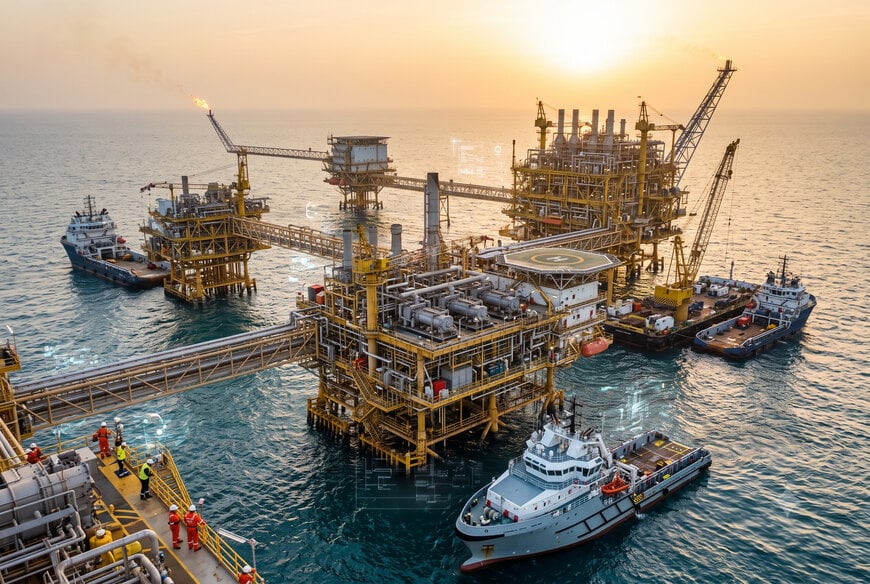
Offshore hydrocarbon extraction in mature, expanding marine basins requires ongoing asset modifications to manage reservoir pressure shifts, handle variable gas-to-oil ratios, and stabilize topside energy efficiency. To maintain production stability and modernize processing facilities, global engineering services company KBR received an engineering and project execution contract from Aramco to implement comprehensive infrastructure enhancements across the Marjan offshore field located in the Arabian Gulf.
Topside Process Optimization and High-Pressure Gas Handling
The engineering scope focuses on retrofitting and optimizing central offshore processing complexes, high-pressure gas compression modules, and offshore utility power distribution networks. As newly drilled offshore wells and satellite platforms tie into central processing hubs, process engineering teams must rebalance fluid separation trains to handle fluctuating three-phase hydrocarbon streams consisting of crude oil, associated gas, and produced water.
Upgrading the gas compression systems expands the field's capacity to collect and compress associated gas rather than flaring it or encountering production curtailments from backpressure constraints. KBR engineering teams will implement process control strategies, automated pressure monitoring, and upgraded compression stages designed to lift associated gas to transmission pressures required for onshore pipeline delivery, directly supporting field-wide recovery efficiency.
Electrification Modernization and Digital Automation Architecture
A core component of the project involves integrating advanced digital automation architectures and modernizing marine electrical infrastructure across the offshore complexes. Deploying upgraded distributed control systems (DCS) and industrial automated safety instrumented systems (SIS) provides central operators with higher-resolution telemetry to monitor mechanical rotating equipment, detect pipeline abnormalities, and execute remote shutdowns safely.
Modernizing the power infrastructure stabilizes electrical loads required by heavy centrifugal compressors and large water-injection pumps. Jay Ibrahim, President of Sustainable Technology Solutions at KBR, noted that integrating offshore engineering with digital architectures and process automation enables operators to align facility operations with long-term asset performance targets. Engineering and technical execution will proceed jointly through KBR operational engineering offices in Houston, Texas, and Al-Khobar, Saudi Arabia, leveraging localized technical personnel alongside global offshore design centers.
Additional Context:
This section details technical specifications and competitive benchmarking not included in the original product announcement.
The Marjan field, located approximately 85 kilometers off Saudi Arabia's northeast coast in the Arabian Gulf, forms the center of Aramco's multi-billion-dollar Marjan Crude Increment Programme. The broader development initiative was structured to increase crude production capacity by 300,000 barrels per day (bpd), bringing total field capacity up to 800,000 bpd, while adding 2.5 billion standard cubic feet per day (bscf/d) of associated gas processing capacity and 360,000 bpd of ethane and natural gas liquids (NGL) recovery.
Engineering and project execution contractors in the Middle East offshore sector operate under rigorous competitive qualification, governed by Aramco's Long-Term Agreements (LTA) for offshore brownfield and greenfield programs. Major peers delivering comparable offshore engineering, procurement, and execution services in the Arabian Gulf include McDermott International, Subsea7, and Saipem. In offshore compression and tie-in programs, Saipem has executed major subsea intervention and pipeline connection packages across the Marjan field under separate LTA arrangements.
Offshore infrastructure modernizations in shallow-to-medium water depths (typically 30 to 60 meters in the Arabian Gulf) require compliance with strict international codes, including API 617 for centrifugal gas compressors and API 14C for offshore safety system design. By pairing front-end engineering design (FEED) and execution modeling with local engineering in Al-Khobar, engineering providers comply with Saudi Arabia’s In-Kingdom Total Value Add (IKTVA) program requirements, which establish competitive benchmarks based on local technical labor utilization, regional supply-chain integration, and specialized technical skill retention.
Edited by Natania Lyngdoh, Induportals editor, with AI assistance.
www.kbr.com
