
www.oilgastechnology.com
01
'26
Written on Modified on
Subsea Production Systems for Deepwater Rovuma Basin Gas Extraction
SLB OneSubsea secures a contract from ExxonMobil Moçambique to deliver deepwater subsea trees, manifolds, and control architectures.
www.slb.com
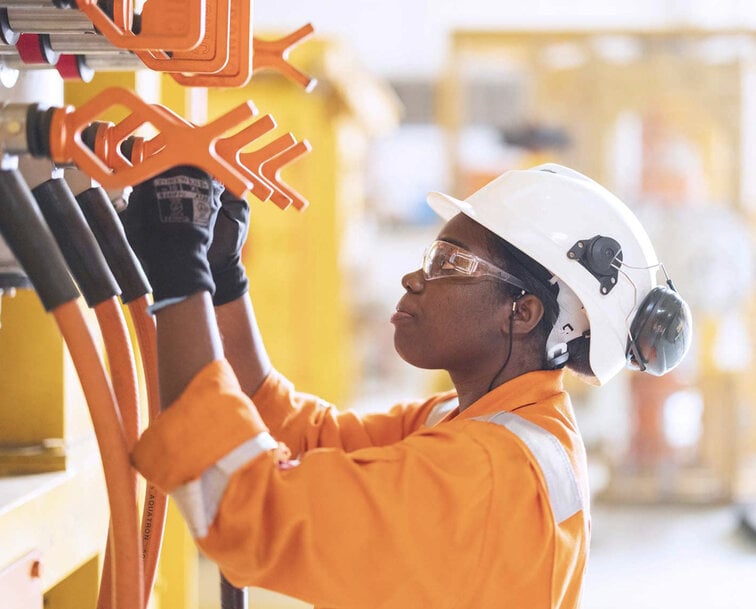
Deepwater natural gas recovery demands robust subsea production architectures capable of withstanding extreme hydrostatic pressure, hyperbaric sealing stresses, and rigorous flow-assurance demands over multi-decade lifecycles. To execute the deepwater development of offshore natural gas reserves in Mozambique, global energy technology provider SLB has announced that its OneSubsea joint venture was awarded a contract by ExxonMobil Moçambique, Limitada, on behalf of the Area 4 joint-venture consortium, to engineer and manufacture subsea production systems for the initial phase of the Rovuma LNG development.
Subsea Production Engineering in Deepwater Gas Architectures
Deepwater gas fields in the offshore Rovuma Basin require specialized seabed equipment to control reservoir effluent, maintain wellbore pressure integrity, and manage gas flow toward surface processing facilities. Because intervention at extreme seabed depths is technically complex and capital-intensive, subsea infrastructure requires uncompromising engineering reliability.
Subsea trees must maintain reliable high-pressure barrier containment while managing multiphase fluids, hydrate formation tendencies, and temperature variations across production choke manifolds. At the same time, hydraulic and electro-optical umbilical systems must establish low-latency, deterministic control channels between topside facilities and subsea actuation systems across long step-out distances.
Contractual Scope and Subsea Equipment Architecture
Under the agreement with ExxonMobil Moçambique and its Area 4 partners—Empresa Nacional de Hidrocarbonetos, China National Petroleum Corporation, Eni, Korea Gas Corporation, and XRG—SLB OneSubsea is responsible for the complete engineering, procurement, manufacturing, and installation support of the subsea production systems.
The hardware and system-level delivery encompasses:
- Subsea Trees: Primary wellhead assemblies fitted with redundant master and wing barrier valves, chemical injection ports, and production choke modules to regulate raw gas extraction directly from deepwater drill centers.
- Subsea Manifolds: Seabed distribution structures that co-mingle production streams from multiple subsea trees into unified flowlines, isolating individual well paths and enabling pigging operations.
- Electro-Hydraulic Umbilicals: Steel-tube and dynamic umbilical bundles routed from the surface to the seabed floor, transmitting electrical power, fiber-optic communication channels, hydraulic actuation fluid, and thermodynamic hydrate inhibitors to subsea distribution modules.
- Subsea Control Systems: Subsea control modules, sensors, and topside master control units providing real-time pressure, temperature, and acoustic monitoring alongside fail-safe electro-hydraulic actuation of downhole and seabed valves.
Operational Strategy and Regional Base Deployment
To facilitate ongoing installation, commissioning, and long-term asset integrity operations, SLB OneSubsea plans to establish a specialized services base within Mozambique. The onshore base will provide technical lifecycle maintenance, component testing, assembly support, and spare-parts warehousing for regional subsea installations, while incorporating domestic technical training and supply-chain logistics.
Additional Context:
This section details technical specifications and competitive benchmarking not included in the original product announcement.
Subsea production systems in the offshore Rovuma Basin operate in water depths generally ranging from 1,500 to over 2,100 meters, where hydrostatic seabed pressures exceed 150 to 200 bar. Under these conditions, subsea hardware must comply with strict engineering guidelines, including API Specification 17D for subsea wellhead and tree equipment, API 17E for subsea umbilicals, and ISO 13628 standards for subsea control systems.
In deepwater gas fields, flow assurance represents a major design constraint. The high methane content, reservoir fluid temperatures, and cold deep-ocean ambient temperatures (typically 3 to 4 degrees Celsius) create severe risks for gas hydrate blockages and wax deposition. Standard deepwater subsea trees mitigate these challenges through high-integrity chemical injection lines integrated directly into the tree body to dose monoethylene glycol or methanol, alongside specialized vacuum-insulated tubing and multi-layer thermal insulation coatings.
The global subsea production market is primarily served by tier-one providers including SLB OneSubsea, TechnipFMC, and Baker Hughes. While competitors often offer integrated engineering, procurement, construction, and installation packages through proprietary subsea architecture alliances, SLB OneSubsea differentiates its platform through standard subsea modularity and digitized control integration.
Furthermore, the Rovuma Basin Area 4 reservoir holds more than 85 trillion cubic feet of natural gas in place. Sizing seabed manifolds and production trees for high-flow-rate subsea tiebacks ensures that the offshore infrastructure can feed projected LNG liquefaction capacities (typically reaching up to 18 million metric tonnes per annum across multi-train onshore and floating liquefaction setups) without introducing critical fluid restriction bottlenecks at the seabed interface.
Edited by Natania Lyngdoh, Induportals editor, with AI assistance.
www.slb.com
To facilitate ongoing installation, commissioning, and long-term asset integrity operations, SLB OneSubsea plans to establish a specialized services base within Mozambique. The onshore base will provide technical lifecycle maintenance, component testing, assembly support, and spare-parts warehousing for regional subsea installations, while incorporating domestic technical training and supply-chain logistics.
Additional Context:
This section details technical specifications and competitive benchmarking not included in the original product announcement.
Subsea production systems in the offshore Rovuma Basin operate in water depths generally ranging from 1,500 to over 2,100 meters, where hydrostatic seabed pressures exceed 150 to 200 bar. Under these conditions, subsea hardware must comply with strict engineering guidelines, including API Specification 17D for subsea wellhead and tree equipment, API 17E for subsea umbilicals, and ISO 13628 standards for subsea control systems.
In deepwater gas fields, flow assurance represents a major design constraint. The high methane content, reservoir fluid temperatures, and cold deep-ocean ambient temperatures (typically 3 to 4 degrees Celsius) create severe risks for gas hydrate blockages and wax deposition. Standard deepwater subsea trees mitigate these challenges through high-integrity chemical injection lines integrated directly into the tree body to dose monoethylene glycol or methanol, alongside specialized vacuum-insulated tubing and multi-layer thermal insulation coatings.
The global subsea production market is primarily served by tier-one providers including SLB OneSubsea, TechnipFMC, and Baker Hughes. While competitors often offer integrated engineering, procurement, construction, and installation packages through proprietary subsea architecture alliances, SLB OneSubsea differentiates its platform through standard subsea modularity and digitized control integration.
Furthermore, the Rovuma Basin Area 4 reservoir holds more than 85 trillion cubic feet of natural gas in place. Sizing seabed manifolds and production trees for high-flow-rate subsea tiebacks ensures that the offshore infrastructure can feed projected LNG liquefaction capacities (typically reaching up to 18 million metric tonnes per annum across multi-train onshore and floating liquefaction setups) without introducing critical fluid restriction bottlenecks at the seabed interface.
Edited by Natania Lyngdoh, Induportals editor, with AI assistance.
www.slb.com
