
www.oilgastechnology.com
15
'26
Written on Modified on
Alfa Laval Selected for Stockholm Exergi’s Large-Scale BECCS Project
Heat transfer equipment supplied through Saipem will support carbon capture, liquefaction and heat recovery at a facility targeting 800,000 tonnes annually.
www.alfalaval.com
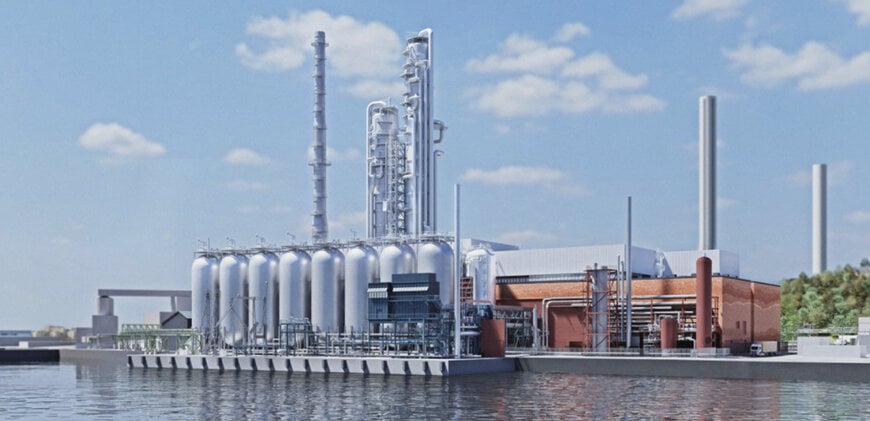
Alfa Laval has concluded an equipment supply agreement with engineering, procurement, and construction contractor Saipem to deliver specialized heat transfer systems for Stockholm Exergi's bioenergy with carbon capture and storage (BECCS) project in Sweden. The installation integrates gas-gas interchangers and industrial plate-and-frame units to capture, liquefy, and store biogenic carbon dioxide while routing reclaimed thermal energy into municipal district heating networks.
Thermal Integration in Bioenergy Carbon Capture Processes
Capturing carbon dioxide from industrial exhaust gas is a highly energy-intensive chemical separation process, primarily due to the steam requirements of regenerating liquid chemical solvents within post-combustion absorption columns. In large-scale combined heat and power plants, unmitigated parasitic energy consumption can compromise overall thermal output and decrease net generation efficiency.
The installation at Stockholm Exergi's biomass-fired combined heat and power plant in Stockholm addresses these thermal demands by embedding heat recovery directly into the carbon capture circuit. Scheduled to enter operational service in 2028, the facility is designed to capture, liquefy, and permanently isolate up to 800,000 metric tons of biogenic carbon dioxide per year. Thermal equipment provided by Alfa Laval manages process heat transfers between hot and cold gas streams, as well as intermediate solvent cooling loops, capturing excess process heat that would otherwise dissipate as exhaust waste.
Flue Gas Interchanging and Municipal Energy Recovery
The core equipment package includes the Alfa Laval Ziepack gas-gas interchanger alongside multiple gasketed and semi-welded plate-and-frame heat exchangers. The gas-gas interchanger preheats incoming treated gas streams while simultaneously cooling hot process streams, maintaining balanced temperature gradients within the absorption columns while minimizing external steam draw.
Residual process thermal energy recovered from the carbon dioxide capture and subsequent multi-stage liquefaction compression train is redirected into the local district heating grid. This operational integration enables the bioenergy facility to maintain heating supply commitments to metropolitan building networks while achieving net-negative greenhouse gas emissions.
Thomas Møller, President of the Energy Division at Alfa Laval, stated that operating carbon capture at this capacity presents significant thermal engineering requirements, noting that high-efficiency thermodynamic recovery determines the commercial viability of large-scale industrial capture installations.
Egil Nybakk, Director BECCS at Stockholm Exergi, noted that capturing and liquefying carbon dioxide from combustion flue gas demands large volumes of energy, and deploying Ziepack interchangers allows the facility to reclaim this process energy and return it directly to the municipal district heating system to support regional carbon removal objectives.
Additional Context:
This section details technical specifications and competitive benchmarking not included in the original product announcement
The primary gas-phase equipment, the Alfa Laval Ziepack, is a fully welded hybrid plate heat exchanger engineered specifically for low-pressure-drop gas condensation, evaporation, and interchanging duties. The core heat transfer element utilizes pairs of laser-welded stainless steel sheets that are hydroformed under high fluid pressure to create internal double-plate channels for liquid media, while the process gas traverses open interplate channels. This geometry limits process gas pressure drop to values below 10 to 50 millibars across large volumetric flow rates, preventing backpressure on upstream flue gas draft fans. For the liquid absorption loop, Alfa Laval gasketed plate-and-frame heat exchangers provide heat transfer coefficients between 3,000 and 6,000 watts per square meter-kelvin, facilitating close thermal approach temperatures down to 1 to 2 degrees Celsius during lean-rich amine solvent interchange.
Direct industry benchmarks for large-scale carbon capture solvent loops and flue gas heat recovery include welded plate systems from Kelvion and Tranter.
The Kelvion K°Block is a fully welded, gasket-free plate heat exchanger designed for aggressive amine solvents and high operating pressures up to 40 bar at temperatures reaching 400 degrees Celsius. The K°Block utilizes four removable side panels within a bolted column structure to allow mechanical chemical cleaning of the plate pack. In post-combustion carbon capture amine loops, the unit provides comparable thermal transfer efficiency to plate-and-frame designs while eliminating gasket degradation from concentrated amine solvents. However, for low-density, high-volume flue gas-gas interchanging, the plate corrugation patterns in standard block-style units present higher gas-side pressure drops than the open-channel crossflow geometries of hydroformed plate bundles.
Tranter manufactures the NovusBloc welded plate heat exchanger and high-efficiency gasketed plate-and-frame units designed for lean-rich solvent interchange and desorber overhead condensation. The NovusBloc operates up to 40 bar and 400 degrees Celsius, featuring an embossed, welded plate pack that achieves turbulent fluid flow at low Reynolds numbers to resist particulate fouling from biomass flue gas particulates. While Tranter units provide high thermal density and pressure containment within compact spatial footprints, the Ziepack platform deployed by Alfa Laval is specifically tailored for direct integration into large-diameter gas ducts and absorption column overheads, minimizing external interconnection pipework in high-volume bioenergy gas flows.
Edited by Natania Lyngdoh, Induportals editor, assisted by AI.
www.alfalaval.com
