
www.oilgastechnology.com
14
'26
Written on Modified on
Subsea Gas Infrastructure Engineering for Rovuma LNG Development
Saipem and Jan De Nul collaborate to deliver preliminary engineering services for Mozambique Rovuma Venture S.p.A. offshore production facilities.
www.saipem.com
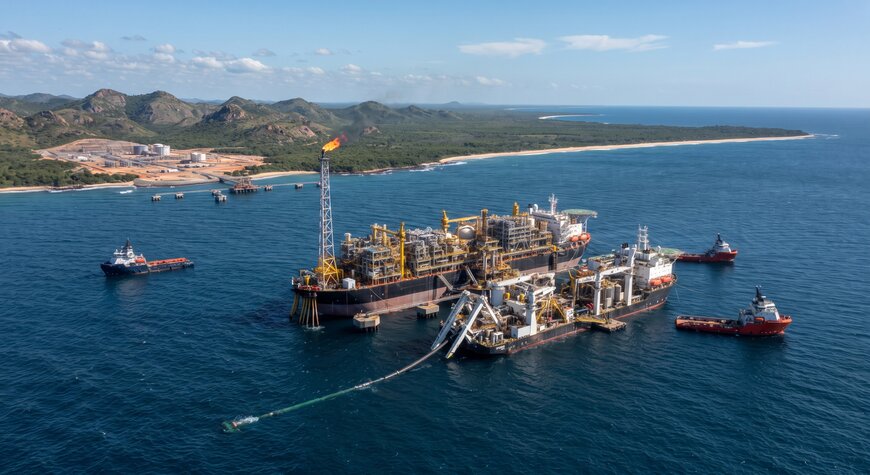
Saipem, in a consortium with Jan De Nul, has entered into a Letter of Intent with ExxonMobil Moçambique Limitada to perform early-stage engineering and technical services for the Rovuma LNG Phase 1 project. The offshore energy initiative focuses on building subsea infrastructure to transport natural gas from deepwater reservoirs to an onshore liquefaction facility.
Consortium Structure and Upstream Scope
The engineering cooperation addresses the technical complexity of deepwater extraction in the offshore Area 4 concession, operated on behalf of Mozambique Rovuma Venture S.p.A. (comprising ENH, CNPC, ENI, KOGAS, and XRG). Managing high-pressure gas transport across marine terrains requires combined capabilities in deepwater structures, marine dredging, and specialized offshore installation. The consortium pairs Saipem's capabilities in deepwater pipeline fabrication and offshore systems with Jan De Nul’s expertise in marine construction, trenching, and seabed operations.
Technical Architecture and Integration
The upstream production architecture connects 18 offshore subsea wells to deliver raw feed gas directly to the planned onshore Rovuma LNG liquefaction trains. The scope encompasses:
- Engineering and configuration of subsea production manifolds designed to gather flow from multi-well clusters.
- Layout design for corrosion-resistant infield flowlines handling unprocessed hydrocarbons under fluctuating reservoir pressures.
- Routing of long-distance subsea gas export pipelines crossing shallow-to-deep marine transition zones.
- Systems integration for subsea umbilicals carrying hydraulic control fluids, electrical power, and chemical injection lines essential for flow assurance and hydrate prevention.
Implementation Phases and Project Execution
The initial agreement encompasses preliminary engineering, technical definition, procurement planning, and execution staging valued at approximately 11 million euro. This preparatory phase defines critical mechanical tolerances, seabed stabilization methods, and interface specifications ahead of manufacturing.
Transition to the full Engineering, Procurement, Construction, and Installation (EPCI) phase remains dependent on a final investment decision by the Area 4 partners and formal regulatory authorizations scheduled for evaluation in 2026. Upon approval, the finalized engineering frameworks will govern the deployment of deepwater pipe-lay vessels, trenching equipment, and automated underwater installation systems to integrate the subsea gathering network with onshore facilities.
Edited by Evgeny Churilov, Induportals Media - Adapted by AI.
www.saipem.com
The initial agreement encompasses preliminary engineering, technical definition, procurement planning, and execution staging valued at approximately 11 million euro. This preparatory phase defines critical mechanical tolerances, seabed stabilization methods, and interface specifications ahead of manufacturing.
Transition to the full Engineering, Procurement, Construction, and Installation (EPCI) phase remains dependent on a final investment decision by the Area 4 partners and formal regulatory authorizations scheduled for evaluation in 2026. Upon approval, the finalized engineering frameworks will govern the deployment of deepwater pipe-lay vessels, trenching equipment, and automated underwater installation systems to integrate the subsea gathering network with onshore facilities.
Edited by Evgeny Churilov, Induportals Media - Adapted by AI.
www.saipem.com
