
www.oilgastechnology.com
31
'26
Written on Modified on
Skid-Mounted Deoxygenation and Desiccant Systems for Biogas Purification
PSB Industries introduces integrated catalytic and dehydration modules designed to condition landfill and digester emissions for strict pipeline injection standards.
psbindustries.com
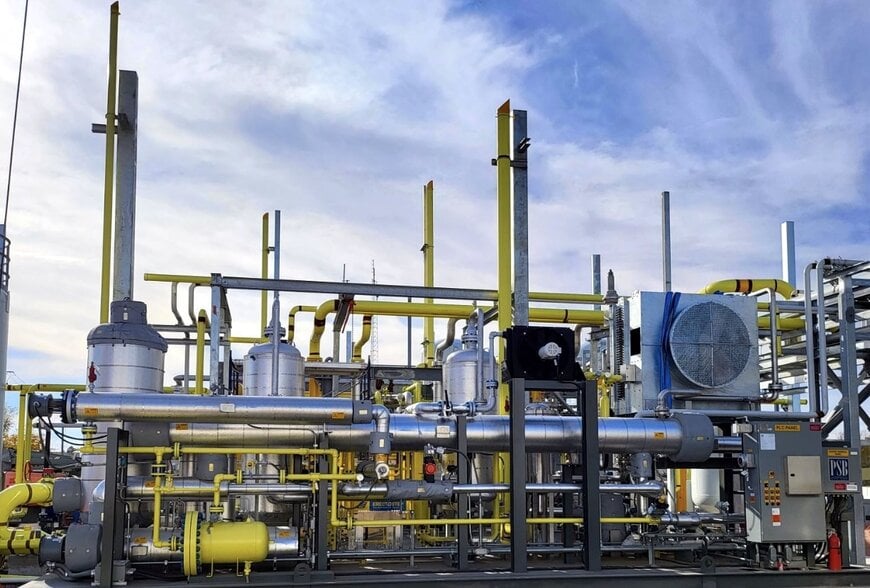
PSB Industries is presenting its custom-engineered Methane Deoxo and Dryer Skids, designed to extract oxygen and moisture from raw biogas streams. These skid-mounted gas purification systems allow operators in the wastewater, landfill, and agricultural sectors to upgrade raw emissions into pipeline-compliant renewable natural gas (RNG).
Catalytic Oxygen Removal and Moisture Dehydration
Raw biogas generated from landfills, wastewater treatment facilities, and anaerobic digesters typically contains elevated levels of oxygen and water vapor, rendering it unsuitable for direct integration into existing renewable natural gas infrastructure. To address these contamination parameters, the integrated deoxygenation (Deoxo) and desiccant drying skids utilize targeted catalytic reactions and dual-tower adsorption.
The Methane Deoxo units process inlet streams with oxygen concentrations ranging from 0.1 percent to 2.5 percent by volume. Through continuous catalytic processing, the systems reduce residual oxygen levels to below 0.1 percent. For applications requiring stricter tolerances, high-specification configurations are capable of achieving oxygen concentrations under 5 parts per million by volume (ppmv). Following the deoxygenation phase, a dual-tower desiccant drying mechanism extracts residual moisture, lowering the water content to a maximum of 7 pounds per million standard cubic feet (lb/MMSCF), while typically achieving operational levels under 4 lb/MMSCF. These measurable reductions prevent condensation and pipeline corrosion.
System Customization and Hydrogen Sulfide Mitigation
The physical architecture of each skid is engineered based on specific site parameters, including precise gas composition, volumetric flow rates, operating temperatures, and baseline pressures. For environments with volatile sulfur concentrations, the purification systems can incorporate an optional hydrogen sulfide (H₂S) guard bed. This critical pre-treatment stage protects the sensitive deoxygenation catalyst from sulfur poisoning, ensuring sustained continuous operation within a broader biogas purification ecosystem.
For highly localized agricultural applications, such as dairy digesters, standardized modular units offer integration with both upstream anaerobic digestion equipment and downstream compression technologies. These standalone and combined gas conditioning configurations will be presented at the RNG Works 2026 exhibition, taking place September 15–17 in Milwaukee, Wisconsin, at Booth 723.
Additional Context
This section details technical specifications and competitive benchmarking not included in the original news release.
In the renewable natural gas conditioning sector, catalytic deoxygenation and solid desiccant drying technologies operate alongside alternative purification methods such as pressure swing adsorption (PSA) and membrane separation. Competitive benchmarking for RNG gas conditioning skids typically focuses on continuous flow capacity, the thermal efficiency of the desiccant regeneration cycle, and the operational lifespan of the platinum or palladium-based catalysts utilized in the Deoxo reactors. Equipment manufacturers such as Guild Associates, Xebec Adsorption, and Air Liquide provide comparable gas upgrading architectures. Unlike membrane separation systems that primarily target carbon dioxide and bulk contaminant removal, integrated catalytic Deoxo and desiccant skids are explicitly measured on their ability to manage exothermic chemical reactions safely while consistently meeting stringent interstate pipeline tariffs, which strictly limit trace oxygen and moisture to prevent systemic pipeline degradation.
Edited by Aishwarya Mambet, Induportals Editor, with AI assistance.
www.psbindustries.com
