
www.oilgastechnology.com
20
'26
Written on Modified on
Quantitative Full-Waveform Inversion for Reservoir Characterization
SLB introduced an elastic seismic processing workflow to extract subsurface rock and fluid properties directly from recorded wavefields for energy exploration.
www.slb.com
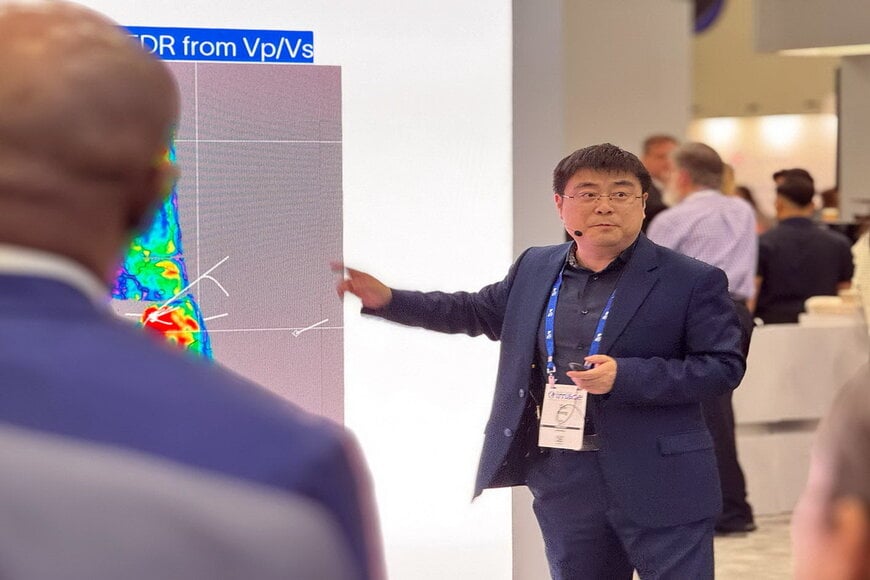
Seismic data processing in hydrocarbon exploration and subsurface characterization aims to resolve geological structures alongside internal rock physics properties. SLB unveiled its quantitative interpretation full-waveform inversion technology, an elastic seismic workflow designed to yield rock and fluid properties directly from recorded seismic wavefields for exploration, development, and reservoir monitoring.
Subsurface Parameter Extraction via Elastic Waveform Modeling
Traditional seismic reservoir characterization relies on sequential, decoupled stages: initial velocity model building, depth migration, seismic amplitude conditioning, and amplitude-versus-offset inversion. Each transfer introduces data-conditioning assumptions and potential error propagation.
The full-waveform inversion workflow replaces these disconnected phases with an integrated inversion cycle. The system simulates pressure waves and shear waves through a computational subsurface model, continuously minimizing the objective misfit between synthetically modeled seismic data and raw field recordings.
By utilizing both wave modes, the elastic solver directly resolves primary wave velocity, compressional impedance, and the ratio of compressional-to-shear velocity. Compressional impedance resolves structural boundaries and rock compactness by coupling acoustic speed with bulk density, whereas the ratio of compressional-to-shear velocity serves as a diagnostic indicator for pore fluids and lithological variations.
Integration with Wellbore Measurements and Lifecycle Applications
Subsurface property cubes generated through this method allow calibration against petrophysical well logs. Interpreters cross-validate inversion parameters against direct in-situ borehole measurements, ensuring consistency between macro-scale wave kinematics and downhole physical properties. The methodology addresses multi-phase asset lifecycles across energy sectors:
Exploration and appraisal: Resolving lithology and fluid variations to de-risk preliminary drilling prospects.
Field development: Providing elastic property volumes to support well placement trajectories and reservoir structural modeling.
Time-lapse monitoring: Applying multi-vintage seismic wavefield comparisons to track 4D fluid saturation changes and pressure variations across active production zones.
Additional Context
This section details technical specifications and competitive benchmarking not included in the original product announcement.
Elastic full-waveform inversion represents an industry-wide transition toward multi-parameter inversion algorithms that eliminate traditional ray-theory approximations. Competing commercial solutions — such as TGS Elastic FWI and Viridien (formerly CGG) Time-lag and Elastic FWI toolsets — also resolve acoustic and elastic properties to bypass standalone post-migration amplitude-versus-offset inversions.
Benchmark criteria in multi-parameter inversion revolve around parameter cross-talk mitigation, computational cost, and low-frequency data requirements. Elastic wavefield inversion introduces multi-parameter non-uniqueness: errors in compressional velocity can bleed into shear-velocity or density calculations. High-performance computing architectures utilizing GPU clusters are standard across commercial vendors to address the computational footprint of solving complete elastic wave equations over vast survey areas.
Edited by Evgeny Churilov, Induportals Media - Adapted by AI.
www.slb.com
