
www.oilgastechnology.com
19
'26
Written on Modified on
TotalEnergies launches global methane emissions monitoring center
MethaneLive leverages real-time data and advanced algorithms to detect, measure, and analyze emissions with a view to reducing them.
totalenergies.com
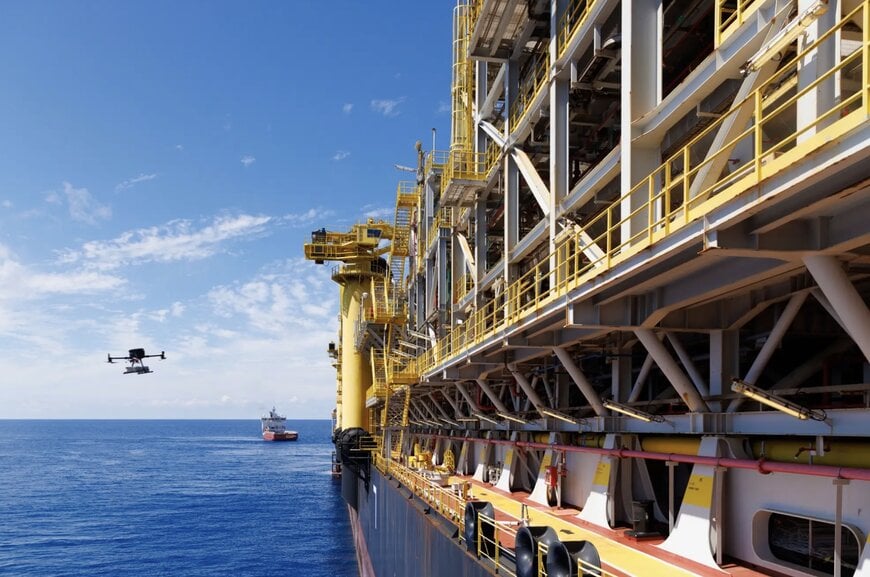
On the occasion of VivaTech’s 10th anniversary, TotalEnergies showcased MethaneLive, its new global methane emissions monitoring center. The platform leverages real-time data and advanced algorithms to detect, measure, and analyze emissions to accelerate their reduction.
Sensor Deployment and Autonomous Detection
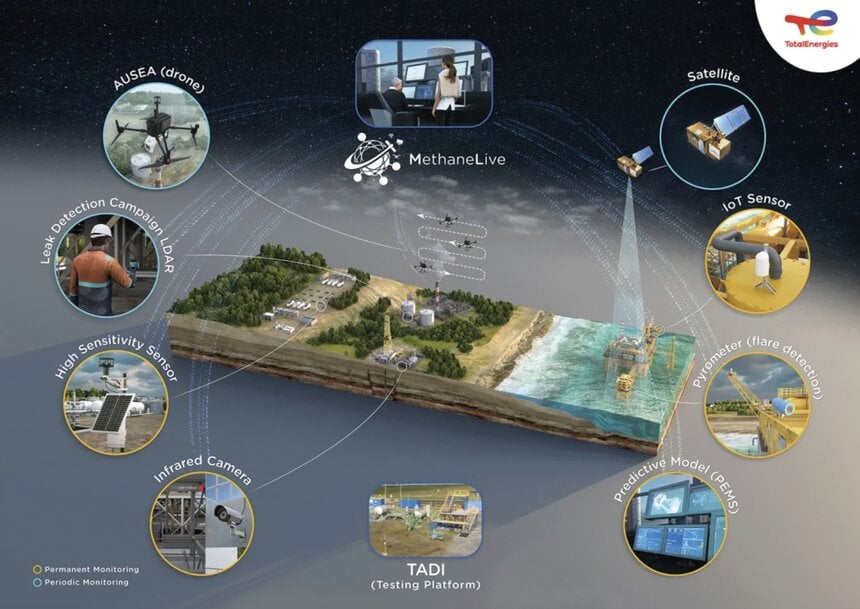
In 2025, TotalEnergies deployed permanent, real-time methane emissions monitoring through the installation of 13,000 sensors across all its operated onshore and offshore Upstream sites. The company is the only operator in the energy sector to have deployed a system of this scale across its operated assets.
These sensors generate a high volume of data. By combining digital tools with the specialized expertise of MethaneLive teams, this information is analyzed in real time to alert operators, isolate the root causes of anomalies, and recommend targeted corrective actions. Since its launch in early 2026, MethaneLive has identified 35 fugitive methane emissions at various facilities that would have been difficult to track without real-time data analysis, enabling their correction via targeted maintenance operations. This data foundation now supports the deployment of agentic artificial intelligence (AI) solutions to target high-emitting equipment and improve the detection of fugitive emissions.
Recognizing the major role of the oil and gas sector in global methane emissions, TotalEnergies has committed to aiming for near-zero methane emissions at its operated Upstream sites by 2030, an ambition established in 2022. This strategy is built on two primary pillars: accurately measuring methane emissions and continuously reducing them. Namita Shah, President OneTech at TotalEnergies, stated that the use of real-time data serves as a concrete driver to make operations safer, more reliable, and more sustainable, positioning digital tools at the intersection of technology and human expertise to fight emissions.
Asset Monitoring and Industrial Data Partnerships
MethaneLive illustrates how TotalEnergies leverages data to integrate AI into its operations to enhance industrial performance. This approach forms part of a broader initiative to scale data and AI applications across the enterprise.
Currently, nearly 3,000 pieces of equipment are monitored across the company’s assets. By analyzing data collected from this equipment, AI systems detect early warning signs of potential failures, allowing teams to proactively plan maintenance operations on industrial facilities. This predictive approach improves asset availability, reduces unplanned shutdowns, and enhances safety metrics. The long-term objective is to extend this system to tens of thousands of additional pieces of equipment monitored by AI models.
To support the deployment of AI at scale, TotalEnergies is investing in collecting real-time information from all operational sites, improving data reliability, structuring data fields, and making it accessible to teams through dedicated platforms. Following VivaTech 2025, TotalEnergies signed two data partnerships with Emerson and Cognite to optimize its data aggregation infrastructure.
Subsurface Analytics and Supercomputing Infrastructure
The company's ambition for artificial intelligence applied to the subsurface is to leverage advanced AI models combined with high-performance computing to harness its geosciences data and knowledge base from exploration through to active production. In geosciences, AI helps streamline basin and field synthesis, improve the interpretation of seismic data, and optimize reservoir development and production, while automating repetitive validation processes and enabling the evaluation of multiple operational scenarios. This strengthens analytical capabilities, helping identify new resource opportunities and optimize their development.
To support these intensive data workflows, TotalEnergies is expanding its high-performance computing capabilities. Pangea 5, a new-generation supercomputer, will increase the company’s total computing power sixfold to support advanced AI applications. Beginning in 2027, this infrastructure will manage growing digital needs, optimize computing times, and deepen the simulation of complex phenomena, particularly in subsurface, electricity, and renewable energy applications.
Technical Lab Collaborations and Renewable Power Supply
TotalEnergies is building on the collaboration announced with Mistral AI at VivaTech 2025, centered around a joint innovation lab. The initial use cases focus on refinery performance analysis, as well as on leveraging large volumes of technical documents and data for Exploration & Production activities.
Concurrently, AI applications are driving a sharp increase in global electricity demand linked to the expansion of data centers, which account for around 3% of global electricity consumption. TotalEnergies is meeting the growing energy needs of these AI-driven systems by providing tailored power solutions to technology companies. The company has signed more than 4 GW of renewable power supply agreements with Google, Amazon, Microsoft, Orange, and Data4, illustrating its ability to support tech customers in their infrastructure decarbonization efforts.
Additional Context
This section details technical specifications not included in the original news release.
Fugitive methane emissions from upstream oil and gas operations primarily stem from valve stem packing leaks, flange gasket degradation, pneumatic controller venting, and incomplete combustion in flare stacks. Methane possesses a global warming potential significantly higher than carbon dioxide, making rapid localization critical.
Traditional detection workflows rely on periodic manual inspections using Optical Gas Imaging (OGI) infrared cameras or aerial flyovers. Continuous monitoring frameworks replace these periodic campaigns by deploying fixed point-sensor arrays on-site. These systems utilize Open-Path Laser Exact Detection or Tunable Diode Laser Absorption Spectroscopy (TDLAS). TDLAS instruments emit an infrared laser beam at a specific absorption wavelength of methane. When methane molecules cross the path, they attenuate the laser intensity according to the Beer-Lambert law, enabling the system to calculate path-integrated methane concentrations in parts-per-million-meter (ppm-m) at high sampling frequencies.
Converting raw telemetry from 13,000 trackside sensors into actionable maintenance alerts requires the deployment of inverse gas dispersion modeling and edge-computed analytics. When a sensor registers a localized methane spike above background levels, the data stream is fed into an atmospheric transport model alongside real-time wind speed, wind direction, and ambient temperature data collected from on-site ultrasonic anemometers.
Advanced algorithms, such as Gaussian plume models or microscale Computational Fluid Dynamics (CFD) simulations, compute backwards from the downwind sensor readings to isolate the exact spatial coordinates of the leaking asset. Agentic AI architectures build upon these models by dispatching autonomous diagnostic routines. These software agents cross-reference the calculated leak location with active Distributed Control System (DCS) process tags—such as localized pressure drops, valve cycling frequencies, and flow rates—to validate the anomaly, predict the emission rate, and generate an automated work order for the field maintenance crew.
Edited by Romila DSilva, Induportals Editor, with AI assistance.
www.totalenergies.com
