
www.oilgastechnology.com
05
'26
Written on Modified on
Integration of Regional Operating Expertise and Academic Research for Offshore Oil Recovery
PETRONAS and regional partners establish a collaborative framework to advance enhanced oil recovery and launch a unified digital infrastructure platform.
www.petroplan.com
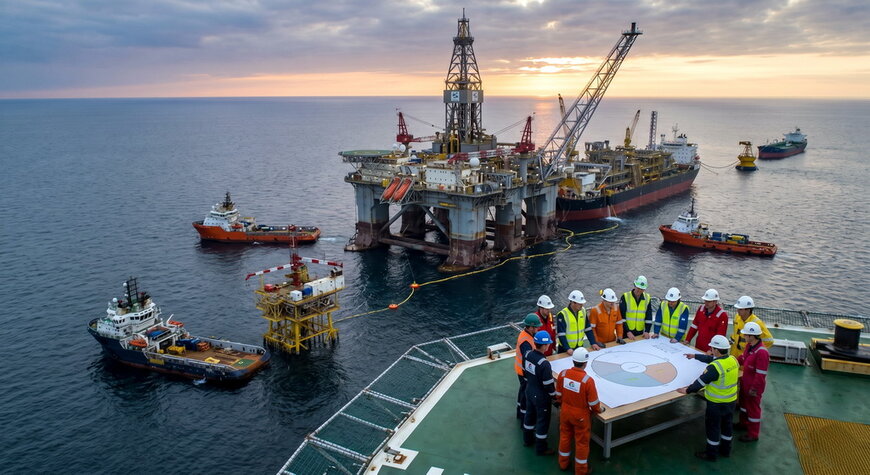
A consortium comprising regional exploration and production operators alongside an academic institution has entered into a collaborative agreement to optimize hydrocarbon extraction. The joint initiative focuses on evaluating and implementing improved oil recovery and enhanced oil recovery (IOR/EOR) technologies across mature offshore acreages.
Operator Alignment and Academic Collaboration
The cross-border initiative involves Petroliam Nasional Berhad (PETRONAS), through Malaysia Petroleum Management (MPM), collaborating with PETRONAS Carigali Sdn. Bhd., PTTEP Sarawak Oil Limited, PTTEP Sabah Oil Limited, PT Pertamina Malaysia Eksplorasi Produksi, and Universiti Teknologi PETRONAS (UTP).
Maximizing the extraction efficiency of mature offshore assets presents complex geological and chemical challenges that individual operators rarely solve in isolation. This structure combines the direct field operational experience of multiple concession holders with the laboratory capabilities of a dedicated research institution to manage the capital risk and technical uncertainty of EOR deployment.
Technical Framework for EOR Maturation
The technical workflow divides responsibilities according to institutional competencies:
- E&P Operators: PETRONAS Carigali, PTTEP, and Pertamina supply historical production data, reservoir models, and operational parameters from active offshore fields.
- Academic Partner: UTP provides core analysis laboratories, fluid-property testing facilities, and high-performance computing clusters.
The joint engineering studies utilize advanced reservoir simulation software alongside physical laboratory validation, such as core flooding tests and fluid compatibility analyses. This dual approach ensures that chemical, gas, or thermal EOR concepts are validated under site-specific temperature and pressure parameters before progressing to pilot scale implementation.
Digital Infrastructure Deployment
Concurrently, MPM has introduced the Malaysia Petroleum Management Digital Intelligence Center (MDIC) to serve as the unified digital infrastructure for regional upstream operations. This centralized system integrates workflow management, subsurface data repositories, and predictive analytics into a single platform accessible by both regulators and Petroleum Arrangement Contractors (PACs).
The architecture leverages artificial intelligence to process multi-source data streams. This consolidation replaces disparate legacy systems, standardizing data exchange formats and automating regulatory submission and approval workflows.
Operational Impact and Industrial Application
The primary objective of the EOR collaboration is to systematically increase the recovery factor of declining offshore reservoirs, thereby extending field economic life and stabilizing production curves. By establishing standardized technical protocols and shared research costs, the partners reduce the development cycle for tailored chemical formulations and gas injection schemes.
On an operational level, the deployment of the MDIC platform provides structured, verified insights that optimize daily planning and execution. The resulting data transparency enhances process stability, accelerates decision-making across the petroleum lifecycle, and allows engineering teams to focus on high-impact optimization tasks rather than data manual aggregation.
Edited by Evgeny Churilov, Induportals Media - Adapted by AI.
www.petronas.com
Digital Infrastructure Deployment
Concurrently, MPM has introduced the Malaysia Petroleum Management Digital Intelligence Center (MDIC) to serve as the unified digital infrastructure for regional upstream operations. This centralized system integrates workflow management, subsurface data repositories, and predictive analytics into a single platform accessible by both regulators and Petroleum Arrangement Contractors (PACs).
The architecture leverages artificial intelligence to process multi-source data streams. This consolidation replaces disparate legacy systems, standardizing data exchange formats and automating regulatory submission and approval workflows.
Operational Impact and Industrial Application
The primary objective of the EOR collaboration is to systematically increase the recovery factor of declining offshore reservoirs, thereby extending field economic life and stabilizing production curves. By establishing standardized technical protocols and shared research costs, the partners reduce the development cycle for tailored chemical formulations and gas injection schemes.
On an operational level, the deployment of the MDIC platform provides structured, verified insights that optimize daily planning and execution. The resulting data transparency enhances process stability, accelerates decision-making across the petroleum lifecycle, and allows engineering teams to focus on high-impact optimization tasks rather than data manual aggregation.
Edited by Evgeny Churilov, Induportals Media - Adapted by AI.
www.petronas.com
