
www.oilgastechnology.com
27
'26
Written on Modified on
Integration of directional drilling and logging technologies in deepwater wells
Baker Hughes and Petrobras are expanding their technical collaboration to implement automated drilling and real-time reservoir evaluation systems across the Santos Basin.
www.bakerhughes.com
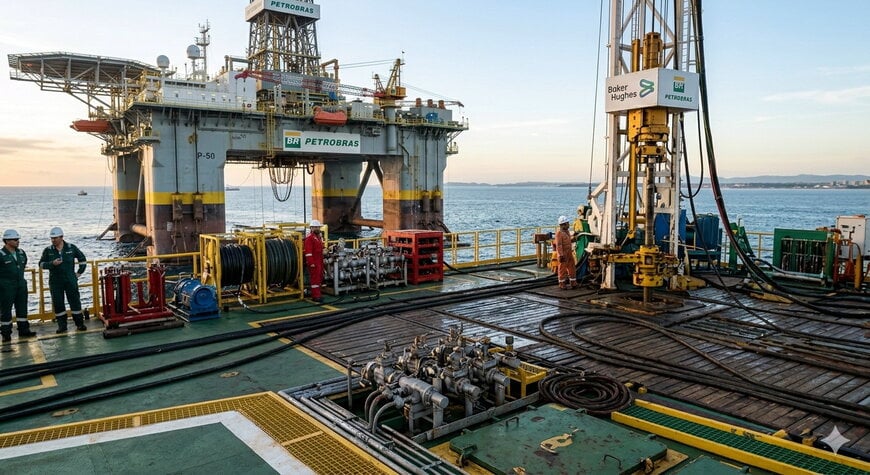
Deepwater oilfield development in Brazil's pre-salt layer presents severe technical challenges, including thick salt sheets, ultra-deep water environments, and complex subsurface geologies. These conditions expose drilling equipment to high vibrations, mechanical stress, and variable pressures, which can cause premature tool failure or wellbore instability. Navigating these formations requires precise trajectory control and continuous subsurface data collection to optimize reservoir access while minimizing non-productive time. Addressing these complexities demands integrated engineering workflows and specialized tool combinations beyond standard drilling assemblies.
Technical solution and asset responsibilities
The technical solution integrates mechanical drilling tools with real-time logging architectures to optimize wellbore construction. Under the extended agreement, Baker Hughes provides and manages the specialized hardware and analytical services, while Petrobras oversees reservoir integration and well planning.
The deployment centers on three primary technologies:
- Rotary steerable systems: Automated units provide continuous 3D steering control, maintaining the planned well trajectory through closed-loop guidance mechanisms without interrupting drill string rotation.
- Logging-while-drilling tools: Sensors integrated directly into the bottom-hole assembly measure formation properties, petrophysical data, and wellbore geometry during excavation, transmitting data via mud-pulse or electromagnetic telemetry.
- Extended-life drill bits: Tailored cutter geometries and advanced material compounds reduce mechanical wear and thermal degradation when cutting through interbedded and abrasive formations.
The system relies on high-speed telemetry interfaces to stream sensor data to the surface, allowing engineering teams to adjust drilling parameters based on real-time geomechanical feedback.
Joint deployment and execution logic
Execution is managed jointly by the Baker Hughes Integration and Solutions team and the Petrobras wells group. The operational strategy integrates multiple technical disciplines into a single managed workflow. Beyond primary directional drilling, the unified team coordinates wireline evaluation, primary cementing, wellbore clean-up, and fishing operations. Specialized drilling fluids are dynamically formulated to stabilize open-hole intervals, while geoscientific modeling tools continuously update structural assumptions as drilling progresses. This collaborative integration ensures that hardware configurations match the specific lithological conditions encountered at each depth interval.
Operational application and impact
The primary application areas are the deepwater oilfields within the Santos Basin. By combining real-time logging data with automated steering, the solution maximizes the contact area with productive reservoir zones. The operational logic focuses on quantifiable process stability: reducing the number of trip-outs required to replace worn drill bits and preventing wellbore deviation. This systematic approach lowers overall drilling torque, stabilizes pressure regimes within the wellbore, and shortens the overall construction timeline for complex offshore developments.
Edited by Evgeny Churilov, Induportals Media - Adapted by AI.
www.bakerhughes.com
Joint deployment and execution logic
Execution is managed jointly by the Baker Hughes Integration and Solutions team and the Petrobras wells group. The operational strategy integrates multiple technical disciplines into a single managed workflow. Beyond primary directional drilling, the unified team coordinates wireline evaluation, primary cementing, wellbore clean-up, and fishing operations. Specialized drilling fluids are dynamically formulated to stabilize open-hole intervals, while geoscientific modeling tools continuously update structural assumptions as drilling progresses. This collaborative integration ensures that hardware configurations match the specific lithological conditions encountered at each depth interval.
Operational application and impact
The primary application areas are the deepwater oilfields within the Santos Basin. By combining real-time logging data with automated steering, the solution maximizes the contact area with productive reservoir zones. The operational logic focuses on quantifiable process stability: reducing the number of trip-outs required to replace worn drill bits and preventing wellbore deviation. This systematic approach lowers overall drilling torque, stabilizes pressure regimes within the wellbore, and shortens the overall construction timeline for complex offshore developments.
Edited by Evgeny Churilov, Induportals Media - Adapted by AI.
www.bakerhughes.com
