
www.oilgastechnology.com
08
'26
Written on Modified on
Hybrid Renewable Power Integration for Oilfield Operation
Cairn Oil & Gas and Serentica Renewables deploy hybrid solar-wind power to supply industrial energy demand at a Rajasthan oilfield.
www.serenticaglobal.com
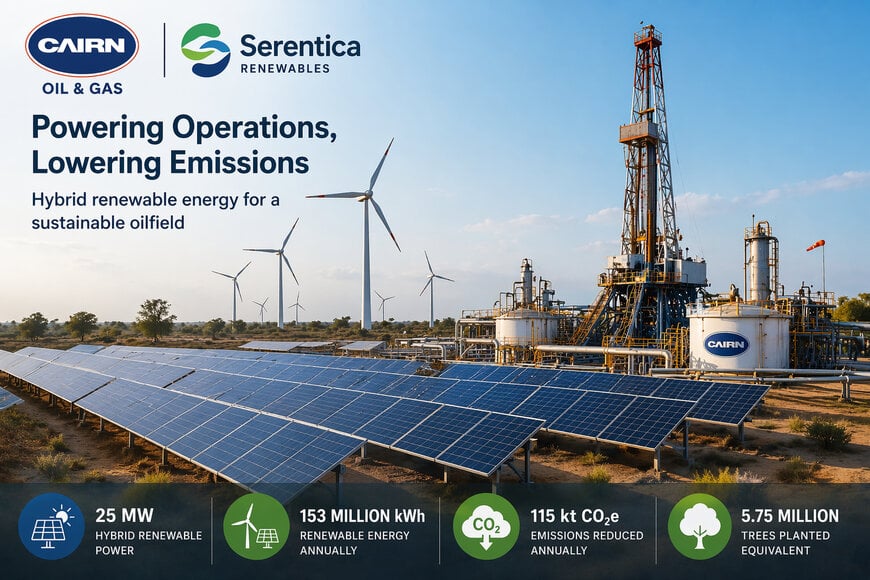
Cairn Oil & Gas and Serentica Renewables have implemented a captive renewable hybrid energy solution to supply part of the power demand for onshore oil production in Rajasthan, integrating solar and wind generation into industrial operations.
Context of the Cooperation
Cairn Oil & Gas, a major upstream operator in India, manages energy-intensive extraction and processing facilities at its Barmer oilfields. These operations require continuous and stable power supply for drilling, fluid handling, and processing systems.
Serentica Renewables, an independent power producer, specializes in firm dispatchable renewable energy systems designed to supply industrial loads with variable but balanced generation profiles.
The cooperation addresses the challenge of decarbonizing continuous oilfield operations while maintaining grid stability and compliance with India’s Renewable Purchase Obligation (RPO) requirements. The integration of renewable sources at this scale requires coordinated generation, transmission, and load management capabilities.
Technical Solution and Responsibilities
The agreement covers the supply of 25 MW of hybrid renewable energy, combining solar photovoltaic and wind generation assets. The system is structured at a 70% Capacity Utilisation Factor (CUF), enabling higher output consistency compared to standalone renewable sources.
Serentica Renewables is responsible for generation and delivery of power from its Gadag facility in Karnataka. The hybrid configuration leverages complementary generation profiles solar output during daytime and wind generation across extended periods to reduce intermittency.
Cairn integrates the supplied energy into its Mangala processing facility in Barmer. The system operates under a captive power framework, where generated electricity is allocated directly to industrial consumption via grid-connected infrastructure. This approach supports industrial decarbonization while maintaining operational continuity.
Deployment and Implementation
The renewable energy is transmitted from Karnataka to Rajasthan through the existing grid network, requiring synchronization with Cairn’s load management systems.
Approximately 20% of the total energy demand at the Mangala facility is now met through this hybrid supply. The implementation involves integration with existing electrical infrastructure, including load balancing and scheduling systems to accommodate variable renewable input.
The agreement delivers an estimated 153 million kWh of electricity annually, aligned with industrial consumption profiles.
Applications and Use Cases
The primary application is continuous power supply for oilfield operations, including:
- Artificial lift systems and drilling equipment
- Crude oil processing and separation units
- Water injection and fluid management systems
The hybrid model demonstrates how renewable energy can be applied in energy-intensive industrial environments that require high reliability.
Results and Operational Impact
The system is expected to reduce operational emissions by approximately 115 kilotonnes of CO₂ equivalent per year.
From a technical perspective, the hybrid configuration improves supply stability compared to single-source renewables, while reducing dependence on conventional grid power. Compliance with RPO mandates is also strengthened through direct renewable sourcing.
This cooperation illustrates the integration of dispatchable renewable energy into conventional oil and gas infrastructure, enabling measurable emission reductions without altering core production processes.
Edited by an industrial journalist Sucithra Mani with AI assistance.
www.serenticaglobal.com
Results and Operational Impact
The system is expected to reduce operational emissions by approximately 115 kilotonnes of CO₂ equivalent per year.
From a technical perspective, the hybrid configuration improves supply stability compared to single-source renewables, while reducing dependence on conventional grid power. Compliance with RPO mandates is also strengthened through direct renewable sourcing.
This cooperation illustrates the integration of dispatchable renewable energy into conventional oil and gas infrastructure, enabling measurable emission reductions without altering core production processes.
Edited by an industrial journalist Sucithra Mani with AI assistance.
www.serenticaglobal.com
