
www.oilgastechnology.com
25
'26
Written on Modified on
Giving Oil Wells a Second Life: An Interview with Phil Cruver, CEO of Geo2Watts (Part 2)
Combining multiple engineering disciplines, from theoretical models to industrial systems, storage performance and long-term reliability, efficiency, lifetime, and comparison with conventional storage.
www.geo2watts.com
Read Part 1 of The Interview
OGT: The Borehole Battery™ Platform (BBP) integrates several complex technologies, including high-temperature heat pumps, expansion power systems, turbomachinery, and subsurface thermal storage. What were the biggest engineering challenges in combining these disciplines into a single integrated system?
Phil: The biggest engineering challenge has been integrating technologies that traditionally live in very different disciplines and making them operate as one coherent, reversible energy system.
High-temperature heat pumps, turbomachinery, power-generation equipment, thermal storage, and subsurface well engineering are all mature fields individually. The difficult part is optimizing the interfaces between them. A decision that improves one subsystem can easily reduce the performance of another, so the design must be approached as an integrated thermodynamic system rather than as a collection of components.
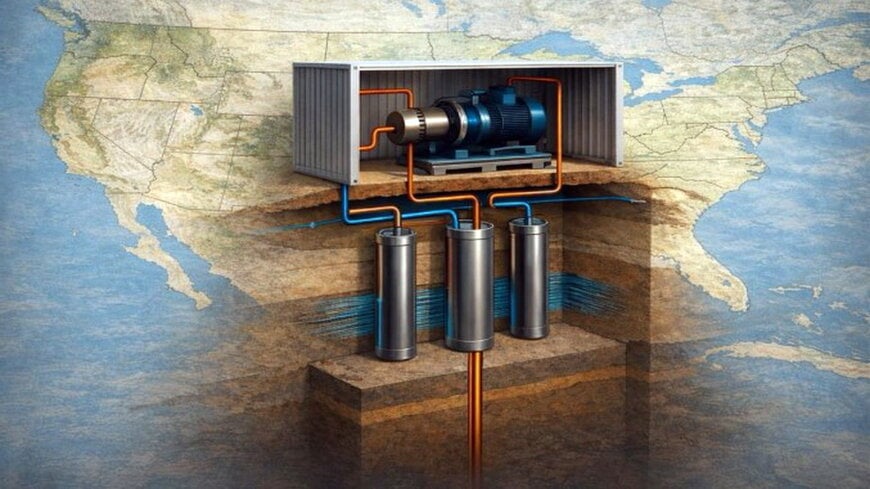
One of the key challenges is temperature. We want to operate hot enough to store meaningful amounts of energy and achieve strong system performance, but we also must remain within the practical temperature limits of existing well construction, casing, cement, seals, and surface equipment. That means carefully managing the thermal envelope of the Borehole Battery while maintaining long-term integrity of the well.
Another major challenge is reversibility. The aboveground system must efficiently move energy in both directions: charging the BBP by converting electricity into stored thermal energy, and then discharging it by converting that heat back into electricity through the expansion system. Designing turbomachinery and heat exchange equipment that performs effectively across both operating modes requires careful optimization of temperatures, pressures, flow rates, controls, and transient behavior.
The subsurface side presents a different set of issues. We must understand how heat moves through the wellbore and surrounding formations, how multiple wells can be thermally and hydraulically integrated, and how the storage system behaves over repeated charge-and discharge cycles. That is why modeling and digital-twin work are so important before moving to large-scale deployment.
Finally, there is the controls challenge. A commercial BBP must behave less like a collection of mechanical equipment and more like a power-system asset. It needs to respond to electricity prices, grid signals, thermal state of charge, equipment limits, and customer demand while continuously optimizing efficiency and asset life.
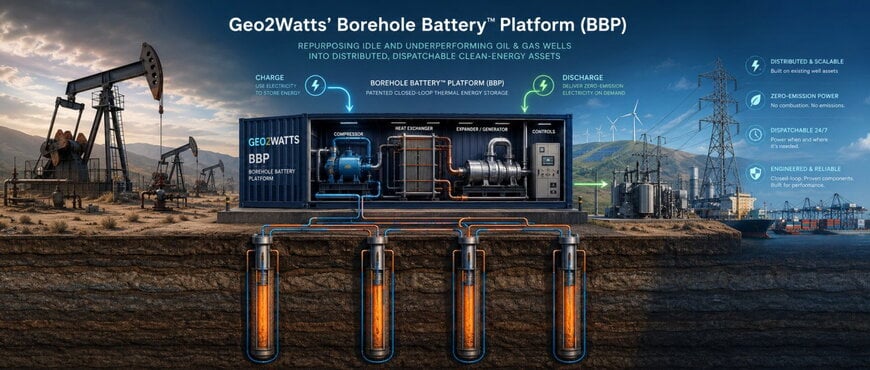
Therefore, our primary engineering task has really been systems integration, bringing together subsurface engineering, thermodynamics, turbomachinery, heat transfer, controls, and power generation into one distributed, dispatchable platform. We believe that integration is also where much of the long-term intellectual property and competitive advantage of Geo2Watts will reside.
From theoretical models to industrial systems
OGT: How did your team transition from theoretical thermodynamic models to a practical system design based on commercially available industrial equipment? Which technologies or engineering solutions were most critical for making the BBP concept technically viable?
Phil: Our transition from theoretical modeling to a practical design came from imposing a very important discipline on the project: wherever possible, build the first commercial pathway around equipment that already exists.
The early thermodynamic work established that the BBP could function as a pumped-thermal energy storage system, using electricity to move heat into underground storage and then recovering that energy later through an expansion and generation cycle. But proving the thermodynamics was only the first step. The more important question became: Can we assemble this system using industrial equipment with known performance, supply chains, maintenance practices, and operating histories?
That changed the way we engineered the BBP. Instead of designing every component from scratch, we began working backward from commercially available compressors, expanders, turbomachinery, heat exchangers, generators, pumps, valves, and control systems. We then optimized the thermal-storage architecture and operating conditions around what industry could realistically supply.
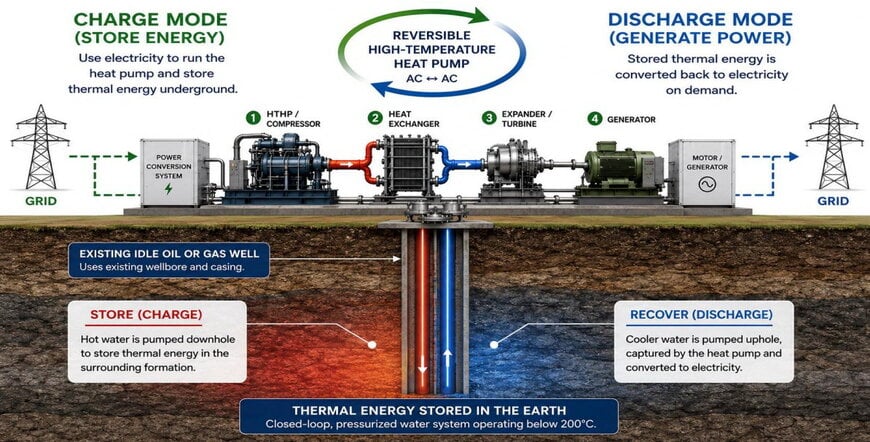
One of the most important breakthroughs was recognizing that reversible high-temperature heat-pump (RHTHP) technology can provide the bridge between charging and generation. In charging mode, the syste uses electricity to concentrate heat and store it in the borehole. During discharge, the thermodynamic process is reversed, and the expansion machinery drives a generator to produce electricity. That bidirectional architecture dramatically simplifies the overall concept because the same integrated thermal cycle supports both energy storage and power generation.
High-performance turbomachinery has also been critical. Modern industrial compressors and expanders can operate at the pressures and temperatures required for this type of system, and advances in recuperative heat exchangers allow us to recover and reuse thermal energy within the cycle rather than continually losing it. Those components are fundamental to making the round-trip economics work.
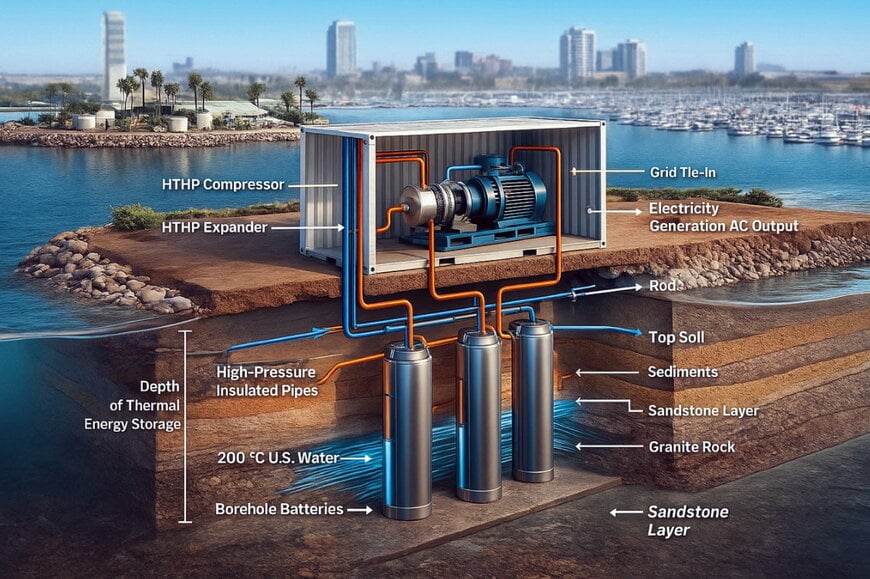
On the subsurface side, another key engineering decision was to keep the borehole within the operating limits of conventional well materials. Our closed-loop design uses pressurized water and limits storage temperatures to approximately 200°C, allowing us to pursue meaningful thermal storage without requiring exotic well construction or pushing existing casing and cement systems beyond practical limits.
Digital modeling has been equally important. We can now model the compressor, expander, heat exchangers, thermal storage, wellbore behavior, and controls as one integrated system and evaluate how changing one parameter affects the entire plant. That has allowed us to move from a conceptual thermodynamic cycle toward an equipment-level plant design.
Perhaps the most important lesson has been that Geo2Watts does not need to invent an entirely new industrial supply chain to make the BBP viable. Much of the necessary equipment already exists in the power, oil and gas, petrochemical, and industrial-gas industries. Our innovation is in how those proven technologies are integrated with repurposed well infrastructure to create a new class of distributed, dispatchable LDES.
That approach also gives us a much faster path to commercialization: prove the architecture initially with commercially available machinery, learn from real operating data, and then optimize future generations of equipment specifically for the BBP.
Storage performance and long-term reliability
OGT: Unlike electrochemical batteries, BBP uses underground geological formations as a thermal storage medium. How does the system maintain performance over long operating cycles? How does Geo2Watts address potential degradation of the underground formation’s thermal capacity, pressure changes, or changes in storage efficiency over decades of operation?
Phil: One of the important advantages of the BBP is that the storage mechanism is fundamentally different from an electrochemical battery. We are not relying on chemical reactions that gradually consume or degrade active materials, and we are not using the underground formation as a pressure vessel that must be repeatedly charged and depleted. It is a closed-loop thermal storage system built around the existing wellbore and surrounding subsurface environment. Heat is transferred into and out of the underground storage system through a controlled heat-exchange process. The working fluid remains contained within the closed loop, so we are not injecting and producing formation fluids during normal operation.
That distinction is important for long-term performance. In a battery cell, degradation is largely driven by irreversible electrochemical changes. In thermal storage, the principal engineering questions are different: heat retention, thermal cycling, material durability, well integrity, and the ability of the storage volume to repeatedly accept and release heat. We designed around those issues from the beginning. For example, our current architecture uses pressurized fresh water in the closed loop and limits operating temperatures to approximately 200°C. That temperature ceiling is intentional. It allows us to achieve useful energy density while remaining within practical limits for existing casing, cement, seals, and other well materials.
We also do not expect the formation's fundamental ability to store heat to be “used up.” Rock does not lose its heat capacity in the same way that an electrochemical battery loses charge capacity with cycling. What can change over time is the thermal distribution around the well. In fact, repeated cycling can create a relatively stable thermal envelope in the surrounding material. The engineering objective is to understand that behavior and manage charge and discharge rates so that thermal losses remain predictable.
Pressure is similarly controlled primarily within the engineered closed-loop system rather than by repeatedly changing reservoir pressure. Pumps, valves, heat exchangers, instrumentation, and controls maintain the required operating conditions, while continuous monitoring can identify changes in temperature, pressure, flow, or well integrity long before they materially affect performance.
This is where digital-twin modeling becomes especially valuable. By combining subsurface thermal models with actual operating data, we can track the thermal state of charge, heat migration, cycling behavior, and equipment performance over time and continuously refine how each BBP is operated.
Ultimately, we believe the durability proposition is one of the most compelling aspects of thermal storage. There is no electrochemical cell chemistry to exhaust and no requirement to replace thousands of battery modules after a finite number of cycles. The objective is to engineer the wellbore and thermal system as long-life infrastructure, much more like a power plant or pipeline asset than a conventional battery, with maintainable aboveground machinery and a subsurface storage asset capable of operating over decades.
Efficiency, lifetime, and comparison with conventional storage
OGT: How does the BBP compare with conventional LDES, particularly lithium-ion batteries, in terms of efficiency, operational lifetime, scalability, and total lifecycle economics?
Phil: Lithium-ion batteries are an extraordinary technology, and for short-duration storage they are difficult to beat. They have high round-trip efficiency, fast response, a mature supply chain, and enormous manufacturing scale. But LDES is a different engineering and economic problem and the BBP is designed around that distinction.
On round-trip efficiency (RTE), lithium-ion will generally outperform a thermal storage system. We do not believe it is useful to pretend otherwise. But efficiency is only one component of storage economics. For LDES applications, the more important questions become: How much does it cost to add additional hours of storage? How long does the asset last? How much capacity degradation occurs? What needs to be replaced over its operating life? And what value can the system provide at a particular location on the grid?
That is where we believe BBP becomes very interesting. With lithium-ion, increasing storage duration generally means installing more battery cells. The energy-storage component is therefore a substantial part of the incremental cost of adding hours. With BBP, much of the energy is stored as heat underground in repurposed well infrastructure. Once the power-conversion equipment is installed, increasing the thermal storage capacity can potentially be much less expensive than adding equivalent quantities of electrochemical cells. That makes the architecture particularly attractive as you move from four-hour storage toward eight-, twelve-, twenty-four-hour and potentially longer-duration applications.
Operational lifetime is another fundamental difference. Lithium-ion cells experience electrochemical degradation and eventually require augmentation or replacement. The BBP has no electrochemical cell chemistry to consume. The underground thermal-storage medium is intended to function as long-life infrastructure, while the aboveground compressors, expanders, pumps, heat exchangers, and generators are conventional industrial equipment that can be inspected, maintained, rebuilt, or replaced independently.
Scalability is also different. Battery projects generally require new containers, battery modules, inverters, transformers, land, and grid infrastructure for each additional project. Our model is to reuse as much existing oilfield infrastructure as possible, wellbores, industrial sites, substations, electrical connections, roads, and operating expertise. And because idle wells exist in very large numbers, we envision BBP as a distributed, dispatchable storage platform that can be replicated across existing energy-producing regions rather than being limited to a small number of centralized storage sites.
The lifecycle economics therefore need to be evaluated differently. If you compare storage technologies only by RTE or initial cost per kilowatt-hour, you can miss much of their actual value. We look at the total cost and GridValue™ over the life of the asset, including duration, degradation, replacement costs, infrastructure reuse, interconnection, land requirements, maintenance, capacity value, and the value of delivering electricity when and where the grid needs it. That leads to an important distinction: lithium-ion is exceptionally good at moving electricity across a few hours; BBP is being designed to economically move large amounts of energy across much longer periods and to keep doing it for decades.
We don't see BBP as replacing every battery. The grid will need multiple storage technologies. Our objective is to occupy the part of the storage market where long duration, long asset life, infrastructure reuse, and lifecycle economics matter more than maximizing RTE alone.
Geological requirements and deployment readiness
OGT: What are the key geological and technical criteria that determine whether an existing oil and gas well is suitable for conversion into a BBP system? For example, what depth, temperature range, geological formation, and infrastructure conditions are required?
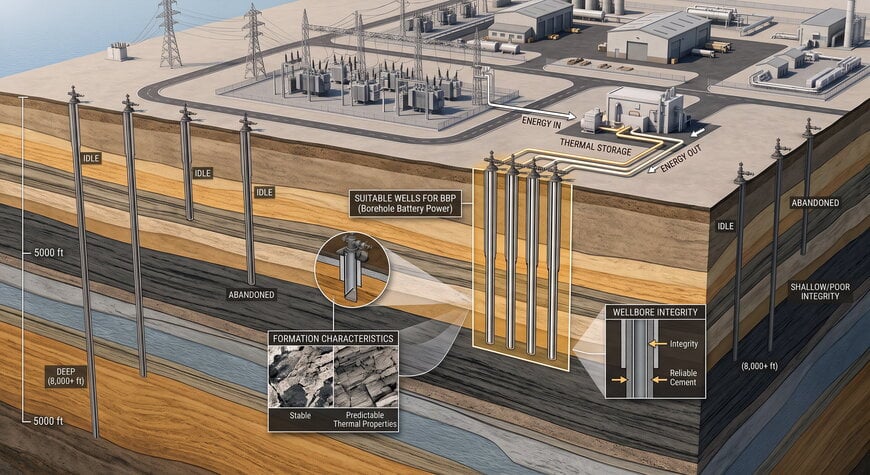
Phil: One of the attractive features of the BBP is that the geological requirements are considerably different from, and generally less restrictive than, those of geothermal energy or other subsurface energy-storage technologies. We are not looking for a geothermal resource, and we do not need a permeable reservoir capable of producing hot fluids. We also are not relying on the formation as a compressed-gas pressure vessel. BBP is an engineered, closed-loop thermal-storage system, so the primary screening criteria are the physical condition of the well, its depth and geometry, the thermal characteristics of the surrounding subsurface, and the existing surface and electrical infrastructure.
Depth is important because it determines how much usable thermal-storage volume we can obtain from an existing well. In the Long Beach oil fields, a typical idle well may be approximately 5,000 feet deep. Deeper wells can provide greater storage opportunity, but depth by itself does not determine suitability. Well diameter, completion configuration, casing condition, cement integrity, and the amount of usable wellbore volume are equally important.
Temperature is another key design parameter. Our current architecture is being engineered around a maximum storage temperature of approximately 200°C. That limit is deliberate. We want a temperature high enough to provide attractive energy density and thermodynamic performance while remaining compatible with conventional oilfield casing, cement, seals, and other well materials. Because the heat is produced electrically by the BBP's HTHP, we do not require the well to already be hot.
Geologically, we are interested in formations that are mechanically stable and have predictable thermal properties. Thermal conductivity and heat capacity influence how heat behaves around the well during repeated charging and discharging. But importantly, we do not require high formation permeability, natural steam, or a particular geothermal gradient. That significantly broadens the population of wells that may ultimately be suitable.
Well integrity is probably the most important technical qualification. Before conversion, a candidate well mus be evaluated for casing condition, cement bonding, corrosion, mechanical integrity, completion history, and any legacy issues that could affect safe long-term operation. Some wells may require remediation before conversion, while others may simply not be good candidates.
Then there is the surface infrastructure, which can be just as important as the subsurface characteristics. The most attractive BBP locations are likely to have existing electrical capacity, substations, grid connections, roads, surface access, operating infrastructure, and sufficient space for the aboveground power-conversion equipment. In many mature oil fields, much of that infrastructure already exists because the field historically operated substantial pumps and other electrical loads.
That is why we tend to think about BBP suitability at the field level rather than simply well by well. A cluster of suitable idle wells located next to an existing substation can be much more valuable than an isolated well with no electrical infrastructure. Multiple wells can potentially be integrated into a larger thermal-storage system and matched to a common power-conversion plant. Therefore, our ideal candidate is not necessarily the deepest or hottest well. It is a mechanically sound well, or cluster of wells, with sufficient usable depth and storage volume, predictable thermal characteristics, and strong existing electrical infrastructure.
That is an important distinction for scalability. We are not searching for a rare geological resource. We are looking for existing industrial infrastructure that can meet an engineering specification, and there are very large numbers of wells that can be screened against those criteria.
Potential resource base in California
OGT: California has thousands of oil and gas wells that require long-term management. Based on current assessments, what percentage of these wells could potentially be suitable for BBP conversion?
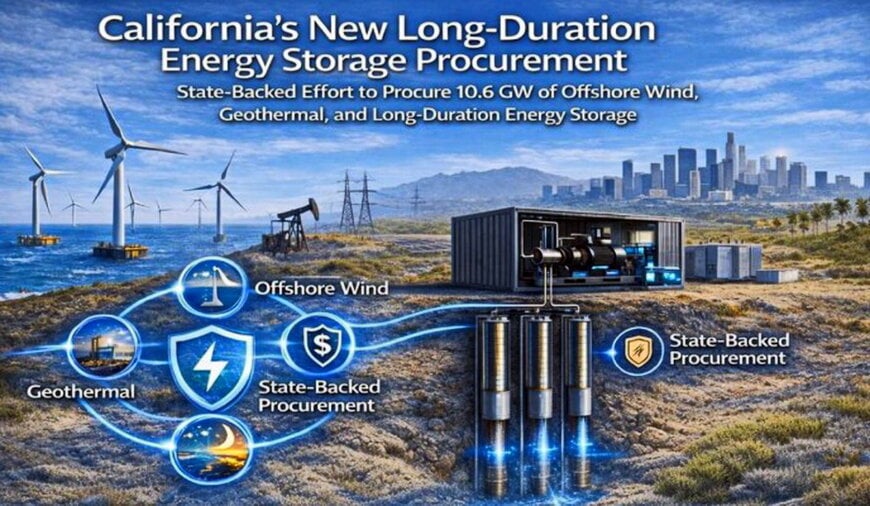
Phil: Our current assessment suggests that the potential is substantial, but I want to be careful about how we define “suitable.” In our statewide California analysis, we screened the well inventory to exclude healthy producing wells and focus on wells with little or no continuing economic value, idle wells, non-producing wells, and wells producing at subeconomic levels. That analysis identified approximately 50,000 potential candidate wells for BBP conversion. Each candidate ultimately must be evaluated for casing and cement integrity, well geometry and depth, thermal characteristics, site access, environmental conditions, proximity to other wells, and, very importantly, the availability of existing electrical infrastructure.
Therefore, I would describe the opportunity in two stages. At the statewide screening level, we see tens of thousands of potential candidates. The next step is field-by-field qualification to determine what percentage of those wells meet our mechanical, thermal, regulatory, and economic requirements. And we don't need every well to qualify for this to become a very large market. That is one of the things we find most exciting about the opportunity: we are starting with an enormous inventory of existing energy infrastructure and progressively screening it to identify the highest-value assets for redevelopment.
Edited by Evgeny Churilov, Induportals Media - Adapted by AI.
www.geo2watts.com
